

When considering a job opportunity in Singapore, it’s important to evaluate more than the salary. In reality, commuting stress, living costs, work permits, and financial adjustments can significantly affect the experience.
A Singapore job for Malaysians feels like a major financial step up for many people. The currency advantage, higher pay bands, and wider career exposure make Singapore especially attractive for fresh graduates and mid-career professionals.
But salary conversion is only the first layer. Working in Singapore often reshapes your daily routine, sleep schedule, transportation habits, spending patterns, and long-term savings structure. Some Malaysians thrive after moving into this rhythm. Others burn out quickly because they prepared for the job offer but not the lifestyle around it.
If you’re considering working in Singapore in 2026, this guide covers what Malaysians should realistically prepare before accepting an offer.
Read More: 10 Best Online Hair Care Product Stores in Singapore
What Malaysians Usually Prepare First & Where They Stop Too Early)
Most people start with the obvious checklist: passport, resume, certificates, work pass, a bit of savings, and a plan to get to work. All of that is correct, but still not enough.
Where things go wrong is when planning stops at “offer letter secured.” The first month is where surprises hit: pass timelines, rental deposits, transport costs, and the mental strain of commuting (especially if you’re crossing the border daily).
Understand Which Singapore Work Pass You Actually Need
Singapore employment requires a valid work pass. Malaysians can’t legally start work just because a company issued an offer letter.
Here’s the practical way to think about it:
1. Employment Pass (EP)
This is typically for professional, managerial, executive, and specialist roles. In 2026, EP eligibility includes meeting the EP qualifying salary and, for many applicants, passing the COMPASS framework. It’s also worth noting that the published EP minimum qualifying salary for new applications rises from 2027, which matters if you’re applying late in 2026 and your paperwork spills into the next year.
2. S Pass
Generally used for mid-skilled or associate professional roles. It has a lower minimum than EP, but comes with employer quota and levy requirements. Like EP, minimum qualifying salary floors for new applications are also scheduled to rise from 2027.
3. Work Permit (WP)
This is typically for specific sectors/occupations with tighter restrictions and different employer obligations.
Two important reality checks
First, your employer usually applies for your pass. Second, timelines and outcomes vary, so you should never quit your current job or relocate based purely on “verbal confirmation.” This is also the area where scammers love to misuse pass terminology, so treat any recruiter who pressures you to “pay to process a pass” as a red flag.
Important Documents Malaysians Should Prepare
You don’t need a mountain of paperwork, but you do need the right items ready, in the right format.
Start with these:
- Passport with sufficient validity (renew early if it’s nearing the common entry validity threshold).
- CV in a concise format (Singapore employers generally prefer direct, achievement-based writing).
- Certificates/transcripts for roles that require verification.
- Reference letters where relevant (especially for senior hires or industry switches).
- Digital copies of everything, stored so you can access them on mobile.
Practical mini-checklist
Keep one folder (cloud + offline) containing:
- Passport scan
- CV (PDF + editable)
- Certificates/transcripts
- Employment contract
- Any pass-related correspondence (especially if you’ll be commuting while onboarding)
The Retirement Shift Malaysians Overlook: “No EPF” (And Usually No CPF Either)
This deserves a dedicated section because it changes how your finances behave.
In Malaysia, EPF deductions and employer contributions create a forced-savings system. In Singapore, the equivalent retirement system is CPF. However CPF contributions are generally required for Singapore Citizens and Permanent Residents, and foreign work-pass holders are typically exempt.
So for many Malaysians working in Singapore, the day-to-day feeling is: take-home pay looks higher, but retirement saving becomes less automatic.
The fix isn’t complicated, but it requires intention. Most people do some combination of:
- An automated monthly transfer into a dedicated “retirement/investing” bucket
- A separate emergency fund (because cross-border life has more moving parts)
- Voluntary EPF self-contribution if they want to keep growing Malaysian retirement savings while earning SGD
Read More: EPF at 55 or 60? Here’s What the World Bank Recommends
The Biggest Lifestyle Decision: Commute From Johor Bahru Or Rent In Singapore?
This is the decision that shapes your energy, time, and long-term sustainability.
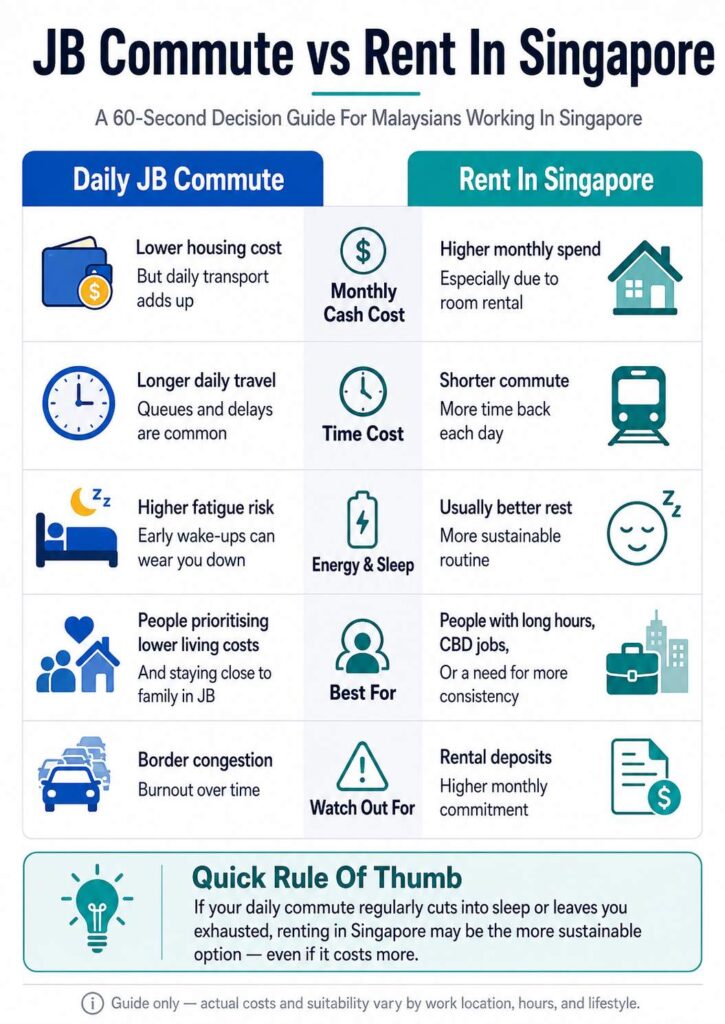
If you commute daily (JB → SG)
The financial upside is clear: you avoid Singapore rental prices and stay close to family. But the hidden cost is the daily grind: queues, unpredictable delays, and the compounding fatigue of early mornings and late returns. Some people adapt. Others feel fine for 2–3 months and then suddenly hit a wall.
If you rent in Singapore
You pay more monthly, but you usually gain back time, sleep, and consistency. If your workplace is far from checkpoints, if you work long hours, or if your role is demanding, renting often becomes less of a “luxury” and more of a sustainability choice.
A simple rule of thumb: if your commute regularly steals your sleep, your savings start paying for it anyway, just in a different currency (health, relationships, burnout).
What Daily Living In Singapore Actually Costs For 2026: Realistic Ranges
Many articles say “Singapore is expensive” without showing what a normal month looks like. The point isn’t to scare people, but to help you estimate your real savings after costs.
Food
If you eat like a typical working adult (not extreme budgeting, not daily restaurants), meals tend to fall into two worlds. Hawker meals remain the budget-friendly backbone, while CBD-area lunches and convenience meals cost more. Over a month, the difference between “mostly hawker” vs “mostly convenience” becomes noticeable even if each meal doesn’t feel expensive.
Public transport
Singapore transport is reliable, but it’s pay-per-ride and distance-based. A typical weekday commuter often lands somewhere around S$70–S$140/month depending on distance and transfers. Your actual number will depend heavily on your route and how many trips you do daily.
Room rental (the biggest swing factor)
For many Malaysians, rent is the “make or break” variable. A room rental commonly ranges around S$700–S$1,500/month, with location and room type making the biggest difference. This is why two people with the same salary can have completely different savings outcomes.
Mobile plan
Mobile plans are usually manageable compared to rent and food. Many SIM-only plans sit around S$15–S$25+ depending on the provider and features.
Daily JB ↔ SG commuting cost
If you commute daily, your cost isn’t just the cross-border bus fare. You also need to budget for the “last mile” on both sides: getting to CIQ, then getting from Singapore checkpoints to your workplace, plus occasional surges during peak seasons. Even when the cash cost looks “cheaper than rent,” the time cost can be the bigger bill.
Transportation Realities Malaysians Underestimate
Most Malaysians know “the border is jam.” What people underestimate is how often small disruptions cascade into big delays.
A few practical realities:
- Rain and public holidays can change travel time drastically.
- Queue unpredictability is mentally tiring even when you “plan extra time.”
- If you’re relying on KTM Shuttle Tebrau, tickets can be competitive during peak demand, and you need to be comfortable with fixed schedules and planning ahead.
Singapore Resume And Interview Expectations: What Changes Vs Malaysia
The biggest difference isn’t that Singapore employers are “better” or “stricter”, their expectations just tend to be more structured.
In practice, this usually means:
- CVs are shorter and more achievement-driven (results, metrics, scope).
- Interviews are often direct, with clear competency-based questioning.
- Reliability matters a lot; employers want confidence you can maintain performance consistently.
If you’ve been writing long narrative CVs, this is worth adjusting before you apply.
Common Misconceptions About Singapore Job for Malaysians
Misconception 1: “High SGD salary automatically means huge savings.”
Not necessarily. Rent, transport, and lifestyle inflation can swallow the gap quickly.
Misconception 2: “Commuting from JB is easy forever.”
Some people do it long-term. Others burn out because fatigue compounds invisibly.
Misconception 3: “Singapore jobs automatically have better work-life balance.”
It depends on industry, employer culture, commuting distance, and shift structure.
Misconception 4: “I can ignore long-term retirement planning.”
If your saving is no longer automated, you need a disciplined system,otherwise your lifestyle will quietly expand to match your pay.
Examples Of Realistic Singapore Work Situations
Instead of treating every worker the same, it helps to think in scenarios:
- Fresh graduate working in Singapore: The salary can feel big at first, but room rental, daily meals, transport, and obligations back in Malaysia can reduce savings more than expected.
- Daily JB commuter: Savings can be strong if you keep expenses stable, but the real battle is stamina: sleep, queue stress, and the limited personal time left after commuting.
- Experienced professional renting in Singapore: You spend more monthly, but you often gain better rest, more consistent routines, and more time for networking and career leverage.
Financial Preparation Before Your First Month In Singapore
You don’t need a massive pile of cash, but you do need a realistic buffer.
A good first-month preparation usually includes:
- An emergency fund (because cross-border life has more variables)
- Backup cash for any payroll timing mismatch
- A plan for banking and money movement (so you’re not scrambling mid-month)
- Accommodation deposit planning if renting
- A transport budget based on your actual route
Making Sure You’re Prepared
Working in Singapore can absolutely improve career opportunities and income potential for Malaysians. But the best outcomes usually happen when job seekers prepare for more than just salary conversion. The real shift is lifestyle, stamina, and financial structure, once savings become more self-managed.
At PRESS PR Agency, Malaysia’s reliable PR partner, we help businesses and brands build stronger visibility through strategic PR, digital positioning, and authority-driven content that connects with real audiences across Malaysia and Singapore. Whether your company is hiring regional talent or expanding cross-border visibility, effective PR can shape how people discover and trust your brand online.
Sources
- Singapore Immigration & Checkpoints Authority (ICA) — Entering Singapore / General Entry Requirements (passport validity guidance)
- Singapore Ministry of Manpower (MOM) — Employment Pass: Eligibility (qualifying salary, COMPASS, updates)
- Singapore Ministry of Manpower (MOM) — S Pass: Eligibility (qualifying salary, updates)
- Singapore Ministry of Manpower (MOM) — S Pass: Quota and Levy Requirements (employer quota/levy rules)
- Central Provident Fund (CPF) Board — Who Should Receive CPF Contributions (Citizens/PRs vs foreign work-pass holders)
- Employees Provident Fund Malaysia (KWSP/EPF) — Self-Contribution / i-Simpan (voluntary EPF contribution option)
- Singapore Land Transport Authority (LTA) — Public Transport Fare Calculator (route-based fare estimation)
- Keretapi Tanah Melayu Berhad (KTMB) — Shuttle Tebrau FAQ (service rules and operational details)
- Causeway Link — Singapore Cross-Border Bus Routes/Schedules/Fares (cross-border fare references)
Frequently Asked Questions About Taking a Singapore Job as a Malaysian
What Is The Best Singapore Work Pass For Malaysians?
It depends on your role, salary, qualifications, and sector. Professional roles often fall under the Employment Pass, mid-skilled roles may fit the S Pass (subject to employer quota/levy rules), and some sector-specific roles fall under Work Permit rules. Your employer typically applies for the pass that matches the job.
Can Malaysians Work In Singapore Without A Work Pass?
No. You generally need a valid work pass approved under Singapore’s work pass framework before you can legally start employment.
Do Malaysians Working In Singapore Receive EPF?
Usually not. EPF is Malaysia’s retirement system, and Singapore payroll does not automatically include EPF contributions. If you want to keep building Malaysia retirement savings while earning SGD, you can explore voluntary EPF self-contribution options.
Do Malaysians Working In Singapore Get CPF?
Most foreign work-pass holders are exempt from CPF contributions. CPF contributions generally apply to Singapore Citizens and Permanent Residents.
Is It Better To Commute From JB Or Rent In Singapore?
Commuting can reduce housing costs and keep you closer to family, but it can cost you time, sleep, and energy. Renting in Singapore usually costs more monthly but often improves daily sustainability. The best option depends on your work location, hours, health, and routine.
How Much Savings Should Malaysians Prepare Before Working In Singapore?
Plan enough for first-month costs plus a buffer: transport, food, any rental deposit (if renting), and extra cash for admin delays or unexpected expenses. The more complex your setup (daily cross-border commuting, moving rentals, supporting family back home), the larger your buffer should be.