
If you have been online lately, especially anywhere near Chinese-language social media, meme pages, or repost-heavy platforms, you may have seen people talking about the SBTI test.
Maybe you saw a screenshot. Maybe someone posted their result with suspicious confidence. Maybe you only caught the general vibe: this is like the Myers Briggs Type Indicator (MBTI) test that you commonly see used, but sillier, funnier, and somehow more brutally honest.
That impression is not far off. SBTI is basically a parody personality test. It borrows the familiar idea that a quiz can “type” you into a recognizable category, then swaps most of the seriousness for internet humor, exaggeration, and self-aware chaos.
Read More: A Guide to Understanding Malaysian Slang: Lah, Meh, Mah
What Is The SBTI Test?
At its core, SBTI is a humorous personality-style quiz that riffs on MBTI. It looks like a type indicator on the surface, but the point is entertainment, not scientific measurement.
In simple terms, SBTI is:
- A parody of the MBTI format
- A meme-friendly personality quiz
- Something built for laughs, screenshots, and sharing
- Not a serious psychological tool
For Malaysians, the easiest way to think about it is this: if MBTI is the well-known personality quiz people use to describe themselves, SBTI is the internet’s parody remix of that format.
Why Are People Comparing SBTI To MBTI?
The MBTI comparison is unavoidable because SBTI is clearly playing with that template.
Even people who have never taken MBTI usually understand the basic formula:
- Answer a series of questions
- Get sorted into a type
- Use that type to say something about yourself
That familiarity is exactly what makes SBTI work.
MBTI still has huge cultural recognition. Even though many psychologists do not treat it as a strong scientific instrument, it remains popular in workplaces, social media, dating profiles, and casual self-description.
In China, MBTI talk has become a common icebreaker, shows up in dating contexts, and has even been used by some employers. Malaysia isn’t that different: in local corporate and HR circles, MBTI and similar “personality/psychometric” tools are often used for team profiling, training, or as an extra data point to learn more about candidates, though it’s controversial to use it as a hard screening filter for hiring.
SBTI steps into that space and says, more or less, “If we are going to label ourselves anyway, let’s at least make it funny.”
A better framing is this:
- MBTI already sits in a gray area between pop psychology and personality branding
- SBTI strips away the seriousness and leans fully into parody
- That self-awareness is part of why people enjoy it
What Does SBTI Stand For?
Different posts and write-ups expand “SBTI” in different ways. You’ll commonly see “Silly Big Personality Test” or “Silly Big Type Indicator.”
And yes, those cleaner expansions are likely doing two jobs at once:
- making the trend easier to talk about in public or brand-safe contexts, and
- softening what “SB” is widely understood to be referencing.
The “SB” is commonly explained as shorthand tied to shabi, a crude, insulting Chinese slang term, which signals the quiz is intentionally irreverent and not meant to sound like real psychology.
You do not need to spend too long unpacking the acronym. What matters more is the vibe it communicates:
- This is not a formal personality framework
- This is not meant to sound clinical
- This is a trend born from online humor
- The quiz is in on the joke
How Does The SBTI Test Work?
The mechanics are simple. You answer a series of questions or prompts, usually in a multiple-choice format, and the test assigns you a result category at the end.
What makes SBTI different is not the structure, but the tone. Instead of sounding like a formal personality assessment, the prompts often feel:
- Casual
- Absurd
- Exaggerated
- Mood-based
- Closer to memes than psychology
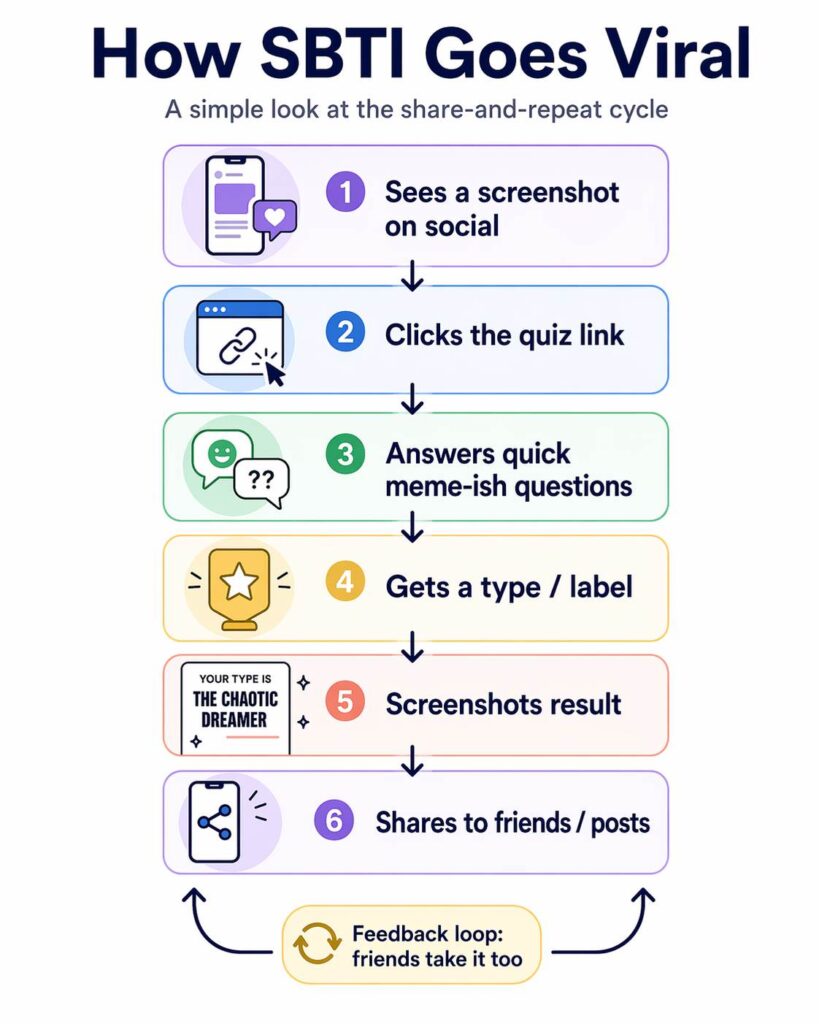
The user journey usually looks like this:
- You click into the test because you saw someone share it
- You answer quick questions that feel funny or oddly familiar
- You get assigned a type or label
- You screenshot the result
- You send it to friends or post it for reactions
That last step is the real engine of the trend.
MBTI Vs SBTI At A Glance
| Aspect | MBTI | SBTI |
|---|---|---|
| Tone | Serious or semi-serious | Humorous and chaotic |
| Goal | Self-understanding | Entertainment and sharing |
| Results | Four-letter types | Meme-style labels (and in some versions, code/type-style outputs made for screenshots) |
| Scientific standing | Heavily debated | Not meant to be scientific |
| Best use | Casual self-reflection | Social fun and self-roasting |
What Kind Of Categories Does SBTI Give You?
One reason SBTI spread so fast is that the categories are memorable.
Instead of giving you something polished or abstract, SBTI tends to hand out labels that feel:
- Blunt
- Exaggerated
- Funny
- Instantly readable
Examples include:
- Boss
- Poor
- Monk
- ATM-er
These labels work because they turn everyday adult life into recognizable internet archetypes. The joke may be built around someone who is always paying for others, always broke, emotionally checked out, or acting more powerful than they really are.
Read More: MUET Malaysia: What It Is & What You Should Do
Why Is SBTI Becoming So Popular In Chinese-Language Circles?
This is the core of the trend. SBTI is not only funny. It fits the mood of contemporary online life, especially in fast-moving Chinese-language digital spaces where humor, identity, irony, and repost culture are tightly linked.
It matches self-roasting humor
A lot of younger internet culture is built around ironic self-description. People joke about being tired, broke, chronically online, emotionally unavailable, or overworked. SBTI packages that humor into a format that feels neat and instantly understandable.
It turns personality into social currency
Once someone gets a result, the result becomes a talking point. People compare types, tag friends, joke in comment sections, and build group-chat banter. The quiz is not just content. It is a prompt for more content.
It feels familiar, but still fresh
Because MBTI is already widely known, SBTI does not need to teach people a whole new framework. It only needs to twist one they already understand.
It is built for screenshot culture
Trends move faster when the output is simple enough to screenshot, repost, and recognize instantly. SBTI checks all of those boxes.
Why Malaysians Will Probably Get It Right Away
Malaysian audiences are well positioned for a trend like this.
Why it translates well locally:
- Malaysians are used to internet culture moving across languages
- Chinese-language trends often spill into wider local social media spaces
- People here already understand the appeal of personality labels
- Shareable quizzes and “too real” memes already do well in Malaysia
SBTI also fits a broader regional sense of online humor. People like jokes that are exaggerated, self-deprecating, and easy to send to friends with “this is literally you” energy.
Why SBTI Can Feel More Honest Than Traditional Personality Tests
One reason SBTI works is that it can feel less fake.
Not more scientific, obviously. Quite the opposite. But sometimes a clearly unserious test feels more believable than a polished framework that tries too hard to sound authoritative.
A result does not need to be true in a rigorous sense to feel familiar. It only needs to capture:
- A social habit
- A recognizable mood
- A common modern-life stereotype
- A behavior pattern people instantly recognize
In that sense, SBTI feels more like cultural commentary than personality science.
Is SBTI Actually Accurate Or Scientific?
Not really.
SBTI should not be treated as a scientifically valid tool for understanding personality. It is not a clinical instrument, not a serious assessment, and not something you should use to make meaningful judgments about yourself or other people.
What it is not:
- Clinically validated
- Psychologically rigorous
- A replacement for real assessment
- A reliable way to define someone’s personality
What it is:
- A meme test
- A social icebreaker
- A playful identity format
- A trend built around relatability, not validity
Even MBTI is controversial in psychology and assessment circles: it has significant critics, while supporters argue it can be useful in limited, appropriate contexts — but it’s still not something to treat like a clinical truth machine.
Is There Any Downside To Taking SBTI Too Seriously?
A little, yes.
The bigger issue is that internet labels can stick. When people repeat a joke label often enough, it can start becoming shorthand for how they see themselves, how friends see them, or how they explain their habits.
The healthier way to approach it:
- Treat it as entertainment
- Enjoy the relatability
- Do not confuse a funny label with a full explanation of who you are
- Remember that meme categories flatten real people into simplified types
Read More: FFK in Malaysian Slang: What Does “Fong Fei Kei” Really Mean?
Should You Try The SBTI Test?
If you approach it as entertainment, sure.
SBTI works best when you treat it as:
- A conversation starter
- A quick laugh
- A group-chat activity
- A fun example of how internet culture remixes old formats
Take it for the joke. Share it for the banter. Keep the result in perspective.
Unpacking the SBTI
SBTI is becoming popular because it takes a format people already know, drops the fake seriousness, and turns it into something more chaotic, funny, and socially shareable.
It is less about discovering who you truly are and more about participating in a very current kind of internet joke, one that feels especially at home in Chinese-language meme culture but is easy for Malaysians to understand too.
At PRESS PR Agency, we help brands make sense of viral conversations, internet culture, and the trends people are actually reacting to online. If you want sharper PR storytelling around fast-moving digital moments, our team can help turn cultural relevance into stronger visibility. Get in touch with PRESS, Malaysia’s top PR agency, to learn more today.
Sources
- TechNode, “How SBTI turned MBTI into China’s latest viral meme”, April 10, 2026.
- Global Times, “SBTI personality test offers youth fun, but beware the trap of labels”, April 14, 2026.
- American Psychological Association (APA), “Personality” (APA Topics page).
- Encyclopaedia Britannica, “Personality assessment: Reliability, validity, methods”.
- BuzzKini, “The SBTI personality test trend”, April 2026.
- JobStreet Malaysia, “Top 5 most popular career personality tests you should know about”, Feb 21, 2023.
- Employment Hero Malaysia, “Should employers use psychometric tests in recruitment?”, Dec 12, 2023.
Frequently Asked Questions About the SBTI Test
What Is The SBTI Test?
SBTI is a humorous personality-style quiz that parodies the format of MBTI. It is designed more for fun, memes, and social sharing than for serious personality analysis.
Is SBTI The Same As MBTI?
No. SBTI borrows the general personality-test format that made MBTI famous, but it is much more openly unserious and joke-driven.
Why Is SBTI So Popular?
It is quick, funny, easy to screenshot, and easy to compare with friends. That makes it perfect for social media and group-chat culture.
Is SBTI Scientifically Valid?
No. It is best understood as a meme test, not a validated psychological tool.
Why Do People Still Like Tests Like This?
Because they are relatable, low-pressure, and socially fun. Even when people know the results are not scientific, they still enjoy the conversation and self-roasting that follow.
Should I Take My SBTI Result Seriously?
Only lightly. It can be funny and oddly relatable, but it should not be treated as a real verdict on your personality.