

If you’ve spent any time in Malaysia, you’ve probably heard someone drop a “fuyoh” at the perfect moment. Usually it happens when something feels a bit too impressive for a plain “wow”, such as a ridiculous plate of food, a sudden glow-up, a new gadget, a wild story.
On paper, you can translate “fuyoh” as “wow” or “damn,” and you won’t be totally wrong. But the real meaning isn’t just the word, it’s the delivery. Tone, timing, and context decide whether it lands as admiration, surprise, hype, teasing, or sarcasm.
That’s why “fuyoh” feels so local. It fits right into the way Malaysians talk: casual, expressive, and full of small reactions that add mood to a conversation, not just information.
So if you want a deeper understanding of what “fuyoh” means, where it likely comes from, and how Malaysians actually use it in real life, here’s the breakdown.
Read More: A Guide to Understanding Malaysian Slang: Lah, Meh, Mah
What Does “Fuyoh” Mean?
“Fuyoh” is an informal Malaysian slang expression used to show admiration, surprise, excitement, or impressed disbelief. It’s the kind of word people use for “wow” or “omg” when reacting to something surprising, impressive, or exciting.
In plain English, depending on the situation, it can mean:
- “Wow!”
- “Wah, not bad.”
- “Damn, that’s impressive.”
- “Serious ah? Nice.”
The key thing is that “fuyoh” is not neutral. It carries energy. Even when it’s short, it sounds emotionally loaded. That’s why Malaysians use it when a regular reaction feels too flat.
What “Fuyoh” Really Means, Beyond Just “Wow”
This is where many articles stop too early. They define the word, give one or two examples, and move on. But if you actually want to understand Malaysian slang, you need to look at how it behaves in real conversation.
“Fuyoh” usually does three things at once:
- It signals reaction
- It adds emotional intensity
- It creates social texture
That last part matters. Malaysians often don’t use slang just to label something; we use it to shape the mood of the conversation. So when someone says “fuyoh,” they’re not only describing a feeling. They’re also making the interaction feel more lively, more local, and more connected.
- A plain “nice” sounds flat.
- A plain “wow” sounds fine.
- But “fuyoh” sounds involved.
It also has a slightly performative quality. Not fake, just socially expressive. You’re reacting in a way that other people around you can feel, which is why it works especially well in group conversations, banter, and casual commentary.
Origin Of The Phrase
A commonly cited explanation is that fuiyoh or fuyoh may be derived from the Hokkien expression 媠唷 (súi–ió), glossed as “beautiful!”.
That origin makes sense in the Malaysian context for a few reasons:
- Hokkien has had a long influence on colloquial speech in many parts of Malaysia, especially in urban and Chinese-majority communities.
- Local slang moves across language boundaries easily, so t gets picked up, respelled phonetically, and eventually treated as everyday Malaysian speech.
- Manglish itself is built on mixing influences (English + Malay + Chinese varieties + Tamil), so borrowings like this don’t feel “foreign” in conversation.
Because slang spreads mainly by speech, spelling becomes flexible. You’ll see variants like fuiyoh and fuyoh used for the same expression, and people spell it the way it sounds to them.
Why “Fuyoh” Feels So Malaysian
To understand why the expression sounds so natural here, it helps to zoom out a little.
Manglish is commonly described as a highly colloquial, informal form of Malaysian English influenced by Malay, Tamil, and varieties of Chinese. It is not the same thing as formal Malaysian English, and it is very context-driven.
That matters because “fuyoh” belongs to this conversational ecosystem. It makes sense in a speech style where:
- Languages are mixed fluidly
- Tone often matters more than literal grammar
- Reactions are social, not just informational
- Small particles and interjections carry a lot of meaning
So “fuyoh” isn’t just a slang word floating on its own. It’s part of a bigger communication habit in Malaysia where emotion, rhythm, and social ease are built into speech.
That’s also why trying to translate it too literally usually weakens it. You can translate the rough meaning, yes, but not the full vibe.
Read More: What Does Gostan Mean: Malaysian Slang Origins and Usage
How Malaysians Actually Use “Fuyoh”
In real-life usage, “fuyoh” is usually placed at the beginning of a sentence or utterance as an immediate reaction.
Typical Usage Patterns
- “Fuyoh, laju betul kereta tu.”
- “Fuyoh, sedap gila.”
- “Fuyoh, new phone ah?”
- “Fuyoh, your results this sem not bad.”
Notice something here: the word often appears before the full thought. That’s because the emotional reaction comes first, then the explanation comes after.
It Often Comes With Local Rhythm
Natural Malaysian delivery may include:
- A short pause
- A slightly stretched vowel
- A follow-up phrase with local cadence
For example:
- “Fuyoh… this one different level.”
- “Fuuuyoh, expensive sia.”
- “Fuyoh, power lah.”
The word itself is short, but the rhythm does a lot of the work.
The Main Meanings In Everyday Speech
Even though the dictionary-style definition is short, the live usage is broader. Here are the main shades of meaning you’ll hear.
Admiration
This is the most straightforward use.
Examples:
- “Fuyoh, your car clean gila.”
- “Fuyoh, your presentation damn solid.”
- “Fuyoh, this house nice.”
In this mode, it means the speaker is genuinely impressed.
Surprise
Sometimes the reaction is less about admiration and more about being caught off guard.
Examples:
- “Fuyoh, that price so high ah?”
- “Fuyoh, you actually finished already?”
- “Fuyoh, suddenly all booked out?”
This use leans closer to “serious?” or “wah, really?”
Hype
This version is more energetic and often a bit exaggerated.
Examples:
- “Fuyoh, tonight confirm happening.”
- “Fuyoh, this promo crazy.”
- “Fuyoh, he went all out.”
Here, the word helps build momentum in the conversation.
Teasing
This is very Malaysian. The admiration is real, but there’s also a playful poke.
Examples:
- “Fuyoh, rich already lah.”
- “Fuyoh, new watch ah?”
- “Fuyoh, now become healthy boy already?”
This works best among friends or people who already know each other’s tone.
Sarcasm
Yes, “fuyoh” can absolutely turn sarcastic.
Examples:
- “Fuyoh… now only you reply.”
- “Fuyoh, so efficient today.”
- “Fuyoh, suddenly expert already.”
Same word, very different intention. This is why tone matters more than literal meaning.
Tone Changes Everything
If there’s one thing tourists and non-locals often miss, it’s this: “fuyoh” is not interpreted by wording alone. It is interpreted by delivery.
Here’s a simple visual guide to how the tone can make a difference.
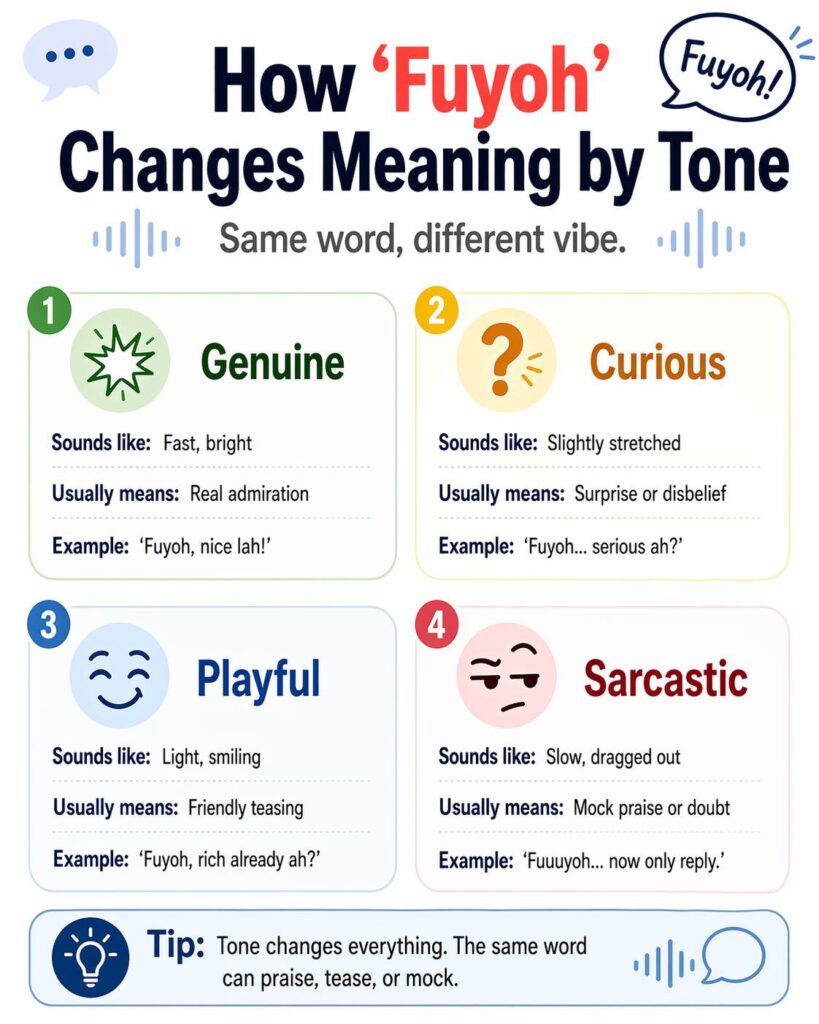
| Tone | How It Sounds | What It Usually Means |
|---|---|---|
| Genuine | Quick, bright, upbeat | Real admiration |
| Curious | Slightly stretched | Surprise or disbelief |
| Playful | Light, smiling tone | Friendly teasing |
| Sarcastic | Slower, dragged out | Mock praise or doubt |
A fast “Fuyoh!” can sound impressed.A slower “Fuuuyoh…” can sound suspicious, cheeky, or sarcastic.
That’s why you can’t really master the word by memorising a one-line definition. You have to hear it in context.
Examples
Here are fuller, more natural example scenarios.
Food
Malaysians love reacting dramatically to food, so this is one of the most natural places for “fuyoh.”
- “Fuyoh, this sambal damn padu.”
- “Fuyoh, the char kuey teow got wok hei.”
- “Fuyoh, this nasi lemak actually damn good.”
This usually means genuine approval, sometimes with a bit of extra theatricality because, well, food conversations here are serious business.
Cars, Tech, And Expensive Things
Another common zone for “fuyoh” is visible upgrades.
- “Fuyoh, changed car already?”
- “Fuyoh, your setup clean wei.”
- “Fuyoh, that camera not cheap right?”
This use often mixes admiration with a hint of curiosity or teasing.
Results, Skills, Or Achievement
It can also be used when someone has done something impressive.
- “Fuyoh, dean’s list ah?”
- “Fuyoh, you learned all that in one week?”
- “Fuyoh, your Mandarin damn fluent now.”
This version often sounds warm and encouraging.
Banter
This is where tone becomes crucial.
- “Fuyoh, now only you want to help.”
- “Fuyoh, gym two days become fitness influencer already.”
- “Fuyoh, one bonus come in then big boss style.”
These can sound affectionate or mildly savage, depending on delivery.
When To Use It, And When Not To
Because “fuyoh” is slang, there’s a natural limit to where it fits.
Good Situations For “Fuyoh”
- Casual chats with friends
- Reactions to food, style, achievements, purchases
- Social media captions or comments with a local tone
- Light-hearted banter
Situations Where It Sounds Off
- Formal presentations
- Academic writing
- Professional emails
- Serious conversations where a playful tone would feel insensitive
That doesn’t mean Malaysians never blur formal and informal styles. We do, sometimes. But if you’re learning the word, it’s safer to treat it as a conversational expression first.
Read More: FFK in Malaysian Slang: What Does “Fong Fei Kei” Really Mean?
“Fuyoh” Vs Other Malaysian Expressions
This is another area where the article can go deeper, because understanding contrast helps readers use the word more naturally.
Fuyoh vs Wah
“Wah” is broader and more neutral.“Fuyoh” feels stronger, more colourful, and more performative.
- “Wah, nice.”
- “Fuyoh, nice wei.”
The second one sounds more emotionally invested.
Fuyoh vs Aiseh
“Aiseh” often carries a slick, stylish, or slightly playful admiration.
- “Aiseh, handsome today.”
- “Fuyoh, handsome today.”
“Aiseh” can feel cheekier. “Fuyoh” can feel bigger.
Fuyoh vs Shiok
“Shiok” is usually about pleasure or satisfaction, especially with food, comfort, or enjoyment.
- “This aircon damn shiok.”
- “Fuyoh, this room cold gila.”
One describes enjoyment. The other reacts to it.
How Pop Culture Helped Push “Fuiyoh” Further
Sources note that the expression was popularised as “Fuiyoh!” by Malaysian comedian Nigel Ng through his Uncle Roger persona in the 2020s.
That doesn’t mean he invented the word. The local expression already existed. But he undeniably helped make it more recognisable outside Malaysia.
The cultural footprint got big enough that “Fuiyoh! It’s Uncle Roger” became the name of his restaurant venture, with the first outlet launching at Pavilion Kuala Lumpur on 11 September 2024.
For a lot of international audiences, Uncle Roger became their first exposure to “fuiyoh.” For Malaysians, though, the word already felt familiar. That mix of old local slang and new internet visibility is part of why the expression now feels both homegrown and widely recognisable.
Why A Small Word Like This Actually Matters
On the surface, “fuyoh” looks like a minor slang item. But small expressions often tell you a lot about how a culture handles emotion.
In Malaysia, especially in informal speech, reactions are often:
- Softened rather than blunt
- Social rather than purely personal
- Layered with humour, warmth, or teasing
“Fuyoh” fits that pattern very well. It lets you react strongly without sounding overly serious. It lets you praise without sounding stiff. It lets you tease without launching into a whole speech.
That’s why it sticks. It’s efficient, expressive, and socially useful.
And for tourists, understanding words like this is often more valuable than memorising textbook phrases. Textbook language helps you function. Local slang helps you read the room.
It’s Not Just The Meaning, But Also The Vibe
“Fuyoh” may look like a simple exclamation, but in Malaysian slang it carries way more than a plain “wow.” It blends admiration, tone, rhythm, exaggeration, and social intent into one small word, which is exactly why it feels so natural in local speech.
At PRESS PR Agency, your reliable Malaysian PR partner, we believe the same principle applies to brand communication. If you want messaging to land in Malaysia, it’s not just about saying the right thing, it’s about saying it with the right local feel. Our PR work helps brands sound culturally aware, relevant, and natural to the audiences they want to reach. Don’t miss out on this chance to boost your brand’s message.
Sources (plaintext, no links)
- Traveloka, “Malaysian Slang That Common To Use in Dailies”
- Wiktionary, “fuiyoh” entry
- Wiktionary, “fuyoh” entry
- Wikipedia, “Manglish”
- Options (The Edge), “Fuiyoh! Uncle Roger’s restaurant finally opens at Pavilion KL”
- Wikipedia, “Nigel Ng” entry
Frequently Asked Questions About ‘Fuyoh’ Usage
What Does Fuyoh Mean In Malaysia?
It generally means something like “wow,” “damn,” or “that’s impressive,” but with a more local, expressive feel. It is commonly used in Malaysia as an interjection for admiration, excitement, or surprise.
Is Fuyoh A Chinese Word Or A Malaysian Slang Word?
It is commonly treated as Malaysian slang today, but its widely cited origin is that it may be derived from the Hokkien expression 媠唷 (súi–ió), glossed as “beautiful!”.
Is Fuyoh The Same As Saying Wow?
Not exactly. “Wow” is the closest quick translation, but “fuyoh” usually sounds more colourful, more local, and more socially expressive. That extra tone is a big part of its meaning.
Can Fuyoh Be Sarcastic?
Yes. Depending on delivery, it can sound genuinely impressed, playfully teasing, or sarcastic. The tone and pacing matter a lot more than the dictionary definition.
When Should You Use Fuyoh?
Use it in casual conversation, especially when reacting to food, style, achievements, purchases, or surprising news. It works best in informal settings, not formal writing or professional communication.
Why Do Malaysians Use Words Like Fuyoh So Often?
Because Malaysian informal speech often blends multiple language influences and relies heavily on tone, rhythm, and shared social cues. Expressions like “fuyoh” make conversation feel more lively and natural.