

Most businesses think SEO is about keywords, but in reality, it’s about intent.
In 2026, keyword matching alone isn’t enough. Google still uses keyword signals to understand relevance, but it also evaluates whether a page is helpful, clearly answers what the user is looking for, and meets the need behind the search.
This matters even more in Malaysia, where searches frequently include location, price, and urgency, and where mobile usage is extremely high.
Malaysia’s internet usage among individuals remains near-universal in recent national survey result.
Your customers aren’t “occasionally online.” They’re searching constantly, often on-the-go, and they expect fast answers.
So a search like:
“best dental clinic Cheras murah”
…is rarely just informational. It’s a shortlist-in-progress. The person wants options, prices, confidence signals, and a quick way to contact or book. If your page doesn’t satisfy that intent clearly, you lose the opportunity even if you rank.
Search intent is what transforms SEO services from a traffic game into a revenue engine.
What Is Search Intent? (Definition)
Search intent refers to the purpose behind a user’s query: what they actually want to achieve when they search.
It answers one simple but critical question:
What is the user trying to do right now?
At a practical level, most searches fall into four outcomes:
- Learning something
- Finding a specific website
- Comparing options
- Taking action
You’ll also hear it called:
- User intent
- Query intent
- Keyword search intent
Modern SEO isn’t about inserting keywords everywhere. It’s about aligning your content with the user’s underlying motivation at the moment they search.
Why Search Intent Matters for SEO in Malaysia
If your content does not match intent, it will struggle to rank consistently,. And even if it ranks, it will underperform commercially.
Malaysia’s digital landscape tends to amplify intent signals because:
1) Mobile is the default
When most users are searching on mobile, attention is shorter and decision-making is faster. People want:
- The answer quickly
- The “best option” quickly
- The next step (call/WhatsApp/book) immediately
This is why “informational-only” pages often fail for transactional searches. Mobile users don’t want a lecture when they’re ready to act.
2) Local visibility often decides the winner
Many service searches naturally trigger local results, and Malaysian users routinely include:
- “near me”
- area names (KL, PJ, Cheras, Subang, Bangi, Johor Bahru, Penang)
- time-based modifiers (“open now”, “today”, “Sunday”)
If you ignore local intent, you’re not just missing rankings, you’re missing the highest-converting traffic.
3) Price sensitivity shows up in the query itself
Modifiers like:
- “murah”
- “harga”
- “budget”
- “package”
signal that the user is already filtering based on affordability. Pages that hide pricing entirely force users back to Google to keep shopping.
When Intent Matches
When your page aligns with what users want:
- Rankings tend to stabilize because relevance is stronger
- Users stay longer because expectations are met
- Conversion rates rise because friction is reduced
When Intent Doesn’t Match
When intent is ignored:
- Users bounce and “back-button” quickly
- Leads leak to competitors
- Rankings can fluctuate because engagement is weak
Search intent is the bridge between visibility and business outcomes.
The 4 Core Types of Search Intent (And How They Work)
1) Informational Intent
Users want to learn or understand something.
Examples:
- “What is SEO”
- “How to register SSM Malaysia”
- “SST Malaysia meaning”
Best content formats:
- Guides
- Educational blog posts
- FAQ sections
- Explainer videos embedded into pages
Goal: Clarity and trust. Don’t overwhelm; answer quickly, then expand.
2) Navigational Intent
Users are trying to reach a specific brand or website.
Examples:
- “Maybank2u login”
- “Shopee Malaysia”
- “LHDN MyTax”
Best content formats:
- Optimized homepage and branded landing pages
- Clear sitelinks structure
- Accurate brand metadata (title tags, organization schema, etc.)
Goal: Remove friction. Give the user exactly where they want to go.
3) Commercial Investigation Intent
Users are comparing options before deciding.
Examples:
- “Best SEO agency Malaysia”
- “Accounting software X vs Y”
- “Best dermatologist KL”
Best content formats:
- Comparison articles
- Reviews (transparent and criteria-based)
- “Best of” lists with a clear evaluation framework
Goal: Help the user shortlist confidently.
4) Transactional Intent
Users are ready to take action.
Examples:
- “Hire SEO agency KL”
- “Book dental appointment Cheras”
- “Buy laptop Malaysia”
Best content formats:
- Service pages
- Product pages
- Conversion-focused landing pages
Goal: Make it easy to act now (call, WhatsApp, book, checkout).
How Search Intent Actually Works in Malaysia (Real Behaviour)
Malaysian users don’t search in clean categories. They search with layered intent.
Common patterns include:
- Location-driven queries: “near me”, KL, PJ, Cheras, Subang, Penang
- Price-driven intent: “murah”, “harga”, “budget”, “package”
- Mixed language searches: English + BM in one query
- Urgency-driven queries: “open now”, “today”, “weekend”
Example: “Aircond service Subang murah today”
That single query contains:
- Local intent (Subang)
- Transactional intent (service request)
- Price sensitivity (murah)
- Urgency (today)
This is why “traditional SEO frameworks” can feel too neat for Malaysia. If your page treats it as just one intent, it under-delivers.
Intent Stacking: One Keyword, Multiple Needs
In modern SEO, one keyword often represents multiple needs.
Example: “Best SEO agency Malaysia”
- Informational: what an SEO agency does and what SEO includes
- Commercial: which agency is better and why
- Transactional: who should I hire and how do I start
What winning content does
It doesn’t force the user to visit three pages. It:
- Educates quickly
- Compares clearly
- Builds trust
- Offers next steps
This is one of the biggest reasons “best of” pages convert: they satisfy multiple intents in one session.
A Simple Intent Mapping Framework (Malaysia-Friendly)
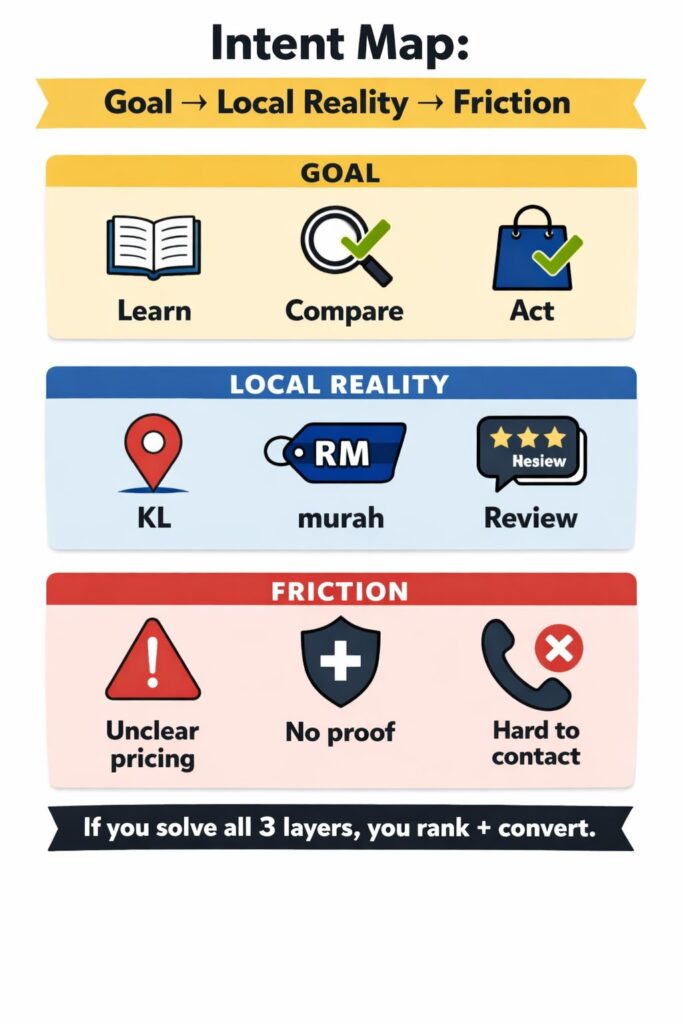
If you want a repeatable method, use this 3-layer intent map:
Layer 1: Goal (What outcome do they want?)
- Learn
- Compare
- Act
Layer 2: Local Reality (What Malaysia context matters?)
- Location convenience (coverage areas, parking, public transport access)
- Price anchors (packages, “starting from” pricing, inclusions)
- Trust signals (reviews, credentials, response speed)
Layer 3: Friction (What might stop conversion?)
- Unclear pricing or “PM for price”
- No proof (no testimonials, no case studies, no before/after)
- Hard to contact (no WhatsApp, no map pin, slow forms)
If your page answers Goal + Local Reality + removes Friction, you don’t just rank, you convert.
How to Identify Search Intent (Step-by-Step)
1) Analyse Google Search Results
Search the keyword and observe:
- Are the top results blog posts or service pages?
- Is there a map pack?
- Are there videos, shopping modules, or “People Also Ask”?
Google’s page layout is a strong clue to the dominant intent.
2) Look at Keyword Modifiers
Words often signal intent instantly:
- “How”, “what”, “meaning” → informational
- “best”, “top”, “review”, “vs” → commercial investigation
- “buy”, “price”, “hire”, “book”, “package” → transactional
- brand names → navigational
- “near me”, area names, “open now” → local + urgent
3) Study Competitor Content (Structure, not just keywords)
Look at:
- Headings and ordering
- How quickly they answer the query
- Whether they show pricing, proof, and next steps
If everyone ranking uses listicles and comparisons, a pure sales page often struggles.
4) Observe SERP Features
- Maps → local intent
- Shopping modules → transactional
- Featured snippets → informational opportunity
- AI-generated summaries → “direct answer” opportunity
SERP Reality Check: What Google Often Shows in Malaysia
Before you write content, check what the SERP is rewarding. In many Malaysian service niches, you’ll see:
- Local Map Pack for “near me” and service categories
- Ads for high-intent keywords (“hire”, “price”, “best”)
- People Also Ask which blends informational + comparison intent
- AI-generated summaries for definitional and explainer queries
Practical takeaway
- If the SERP is maps-heavy, your page must support local conversion: address, hours, WhatsApp, reviews, directions.
- If it’s snippet-heavy, lead with direct answers and scannable lists.
- If it’s comparison-heavy, include criteria, proof, and a shortlist-friendly structure.
Matching Search Intent to Content (Malaysia Examples)
Intent Type | Best Content Format | Malaysian Example |
Informational | Blog guide / FAQ | “What is SST Malaysia” |
Commercial | Comparison / list | “Best accounting firms KL” |
Transactional | Landing page | “Hire SEO agency Malaysia” |
Local | Local page + maps signals | “Clinic near me open Sunday” |
Pro tip: For local + transactional keywords, don’t rely on one blog post. Use:
- A strong service page (conversion)
- Supported by an FAQ or guide (AEO + coverage)
Trust Assets That Increase Both Rankings and Leads (Malaysia-Friendly)
If you want users to trust you faster (and reduce drop-offs), add:
- Pricing anchors: starting-from price, packages, what’s included
- Credentials: certifications, awards, partners, memberships
- Local proof: Malaysia-specific case studies (industry + outcome)
- Review highlights: summarize themes (speed, friendliness, results)
- Fast contact: WhatsApp button + expected reply time
- Service boundaries: what you don’t do (filters bad leads and reduces refunds)
These assets are especially powerful for commercial and transactional intent because they remove uncertainty.
How AI Is Changing Search Intent in 2026
Search intent is no longer just about ranking. It’s about being understood and selected across modern SERP layouts.
What has changed
- AI-generated summaries can answer parts of a query directly
- Users may click traditional results less often when an AI summary is present (independent research has observed reduced clicking in those sessions)
- Google’s AI systems may expand a query into related sub-queries to produce a more complete response, which increases the value of clear structure and coverage
What this means for content
To stay visible, your content should:
- Answer the query early (first 2–3 lines under headings)
- Use scannable structure: bullets, steps, short sections
- Provide unique proof and specificity (examples, Malaysia context, case outcomes)
- Include “next step” pathways for humans (CTAs, checklists, booking)
In 2026, visibility increasingly depends on clarity and usefulness, not just optimization tricks.
AEO Formatting Checklist (Quick wins)
If you want your content to perform in AI-driven search layouts:
- Put a 1–2 sentence answer directly under each main heading
- Use short lists and tables for extractable clarity
- Add a short “How to” section for practical keywords
- Keep definitions consistent (don’t swap terminology randomly)
- Add FAQs that reflect real modifier-based searches (“harga”, “murah”, “near me”, “open now”)
How to Measure If You’re Matching Intent (Not Just Getting Traffic)
You can usually tell intent-match is improving when:
- CTR improves (your title/meta matches what they want)
- Time on page and scroll depth rise (the content meets expectations)
- Leads per visit increases (less friction)
- Search Console queries align better (fewer irrelevant impressions)
For local intent pages, track “money actions”:
- Tap-to-call
- WhatsApp clicks
- Direction requests
- Booking form submissions
If those don’t move, you might be ranking for the keyword but failing the intent.
Which Search Intent Should Malaysian SMEs Focus On First?
Not all intent types deliver equal ROI.
For small businesses (fastest returns)
Prioritize:
- Commercial intent (best / top / review / vs)
- Local intent (near me / area-based searches)
These usually drive faster conversions.
For growing businesses (scaling visibility)
Add:
- Informational content that answers beginner questions and builds topical authority
For established brands (market leadership)
Adopt:
- Full-funnel coverage across informational → commercial → transactional → local
This is how you dominate an industry over time.
Understanding Search Intent to Boost Your Business
Search intent is the foundation of effective SEO. In Malaysia’s fast-paced, mobile-heavy environment, intent determines whether your content simply gets seen or drives real business results.
When you align pages to what people actually want (and remove friction with pricing clarity, proof, and easy contact), SEO becomes more predictable and more profitable.
If you want to turn search intent into measurable growth, PRESS PR Agency, Malaysia’s number one SEO agency, helps businesses build SEO strategies based on real user behaviour and modern search layouts, so you rank with purpose, convert with clarity, and scale visibility in today’s AI-driven search landscape. Get in touch with PRESS to learn more today!
Sources
- Google Search — How Search Works: Ranking results (Google “How Search Works”)
- Google Search Central — Creating helpful, reliable, people-first content (Google for Developers)
- Google Search Central — AI features and your website (Google for Developers)
- Google Search Quality Rater Guidelines — Search Quality Evaluator Guidelines (published 11 Sep 2025; RaterHub/Google)
- Department of Statistics Malaysia (DOSM) — ICT Use and Access by Individuals and Households Survey Report 2024 (release 24 Apr 2025; data year 2024; DOSM)
- Pew Research Center — Google users are less likely to click on links when an AI summary appears in the results (published 22 Jul 2025; Pew Research Center)
- Bank Negara Malaysia (BNM) — Annual Report 2024 (published 24 Mar 2025; BNM)