

Every successful brand begins with a clear understanding of its audience. However, many businesses make the mistake of trying to market to everyone. When messaging becomes too broad, it often fails to resonate with any specific group of customers.
This problem is especially common for startups and companies undergoing rebranding. During these stages, businesses are refining their positioning and deciding who their products or services are actually meant for.
For Malaysian brands competing in a crowded digital marketplace, identifying the right audience is essential. Companies today compete not only with local businesses but also with international brands targeting Malaysian consumers online.
Understanding your target audience allows brands to build stronger marketing campaigns, create more relevant products, and communicate value more effectively.
Research and industry analysis consistently support the idea that stronger customer segmentation enables more relevant marketing and improved performance when paired with strong execution and measurement (Source: McKinsey, 2025).
What Is A Target Audience?
A target audience refers to the specific group of people most likely to purchase or engage with a brand’s product or service.
Instead of marketing to the entire population, businesses focus on consumers who share similar characteristics and needs. This approach allows brands to develop messaging, products, and campaigns that resonate more strongly with their ideal customers.
Common characteristics used to define a target audience include:
- Age, gender, and income level
- Geographic location
- Interests and lifestyle preferences
- Purchasing behaviour and product usage
- Personal motivations or challenges
These attributes help brands better understand how to communicate with potential customers and where those customers are most likely to be reached.
Marketing and advertising research also supports a practical principle: when people perceive messaging as more relevant, engagement and purchase intent tend to increase, which is one reason why message-market fit and targeting matter (Source: ScienceDirect, 2025).
Why Identifying Your Target Audience Matters For Malaysian Brands
Understanding your audience influences nearly every aspect of brand and PR strategy.
From product design to pricing, distribution channels, and marketing campaigns, businesses must align their decisions with the needs and behaviours of their customers.
Some of the key advantages include:
- More effective marketing campaigns because messaging addresses real customer needs
- Improved product development by focusing on real consumer problems
- Higher conversion rates as marketing reaches more relevant audiences
- Stronger brand positioning compared with competitors
For Malaysian brands, audience insights are particularly important because consumer behaviour varies across different regions and demographic groups. Urban consumers in Kuala Lumpur or Penang may behave very differently from consumers in smaller towns or rural areas.
Malaysian audiences also interact with brands across multiple digital platforms such as TikTok, Instagram, Shopee, and Facebook. Knowing where your audience spends time online helps brands design more effective marketing strategies.
Malaysia reality check (2026): define your audience in three layers
Instead of stopping at “who they are,” make your audience definition more actionable with three layers: who → what → where/how.
1) Who they are (reach + demographics)
- Use platform audience insights to estimate where large audiences exist in Malaysia (Source: DataReportal, Digital 2025: Malaysia, 2025).
- Use regional factors like language preference, state/region, urban vs non-urban, and household life stage to avoid generic personas.
2) What they want (jobs-to-be-done + motivations)
- What problem are they trying to solve?
- What’s the emotional driver (confidence, convenience, status, security)?
- What’s stopping them (price, trust, complexity, delivery time, product fit)?
3) Where/how they buy (channel + behavior)
- E-commerce is a major purchase route: Ipsos reported that in 2024, about half of Malaysians had purchased on e-commerce platforms (Source: Ipsos Malaysia, 2024).
- Marketplace behavior matters because platforms influence discovery and conversion, and Similarweb rankings for Feb 2026 place Shopee among the most visited e-commerce & shopping sites in Malaysia (Source: Similarweb, Feb 2026).
What this changes in practice
Instead of “Young professionals in KL,” you get something more usable, like:
- “Young professionals in KL who discover on short-form video and convert on marketplaces,” or
- “Mums in East Malaysia who prefer Bahasa content and buy during payday promos.”
Quick compliance note (especially for targeting lists): If you collect or use personal data for targeting (email lists, CRM segments, WhatsApp broadcasts), ensure your direct marketing practices align with Malaysia’s PDPA, including clear opt-outs (Source: DLA Piper, Data Protection Laws of the World – Malaysia, 2025).
Who Should Define A Brand’s Target Audience?
Identifying a target audience should involve multiple stakeholders within a company. Different teams contribute valuable insights that help shape a realistic understanding of customers.
Stakeholder | Role In Audience Identification |
Founders | Define business vision and long-term strategy |
Marketing teams | Conduct research and audience segmentation |
Sales teams | Share insights from real customer interactions |
Customer support teams | Highlight common customer issues and feedback |
Product teams | Understand how customers use the product |
This collaborative approach ensures the audience definition reflects real market insights rather than assumptions. Customer understanding works best as an ongoing feedback loop: analytics → insights → experiments → updates, because platforms and consumer behavior keep changing (Source: McKinsey, 2025).
When Should Malaysian Brands Identify Their Target Audience?
Audience identification typically happens at several important points in a brand’s lifecycle:
- Launching a new brand: Define your first priority segment before building messaging or spending on ads.
- Rebranding or repositioning: Reassess who you’re for when your promise, pricing, or category changes.
- Entering new markets: Validate whether the same audience definition holds across regions (Peninsular vs East Malaysia, urban vs smaller towns).
- Launching new products: Check if the new offering attracts a different use case or buyer.
Revisiting audience insights during these moments helps businesses remain aligned with changing market conditions.
Where Malaysian Brands Can Discover Audience Insights
Audience insights can be gathered from multiple research sources:
- Social media analytics: audience demographics, engagement patterns, content performance, interests
- Market research reports: category size, purchasing trends, competitor moves, macro shifts
- Customer feedback and surveys: motivations, preferences, objections, and pain points
- Competitor analysis: who they target, what they promise, what they ignore
To strengthen your insights further, add these sources:
- First-party data (highest signal): website analytics, CRM tags, repeat purchase rate, returns, and support tickets
- Marketplace intelligence: top-selling SKUs, search terms, and review language patterns on the platforms you sell through
- Search demand signals: Search Console queries and Google Trends to spot intent differences by region and season
- Category constraints: halal considerations, claims compliance, and category-specific rules that shape who can buy and why
How Malaysian Brands Can Find Their Target Audience
Step 1: Define The Problem Your Brand Solves
Before identifying an audience, businesses must clearly understand the problem their product or service addresses.
For example:
Product | Problem Solved |
Accounting software | Simplifies financial management for SMEs |
Childcare services | Provides reliable childcare for working parents |
SEO services | Helps businesses improve online visibility |
Understanding the problem makes it easier to identify the group of people most likely to benefit from the solution.
Step 2: Analyse The Market Landscape
Brands should evaluate their industry environment to understand demand and competition.
Key research areas include:
- Market size and growth trends
- Competitor positioning
- Consumer expectations
- Emerging industry trends
Market research helps brands quantify demand, map competitors, and spot underserved segments, so they can prioritise the highest-potential audiences with evidence instead of assumptions (Source: Marketing Information Systems overview, LibreTexts, 2025).
Step 3: Segment The Market
Market segmentation divides a large market into smaller groups with shared characteristics. For example:
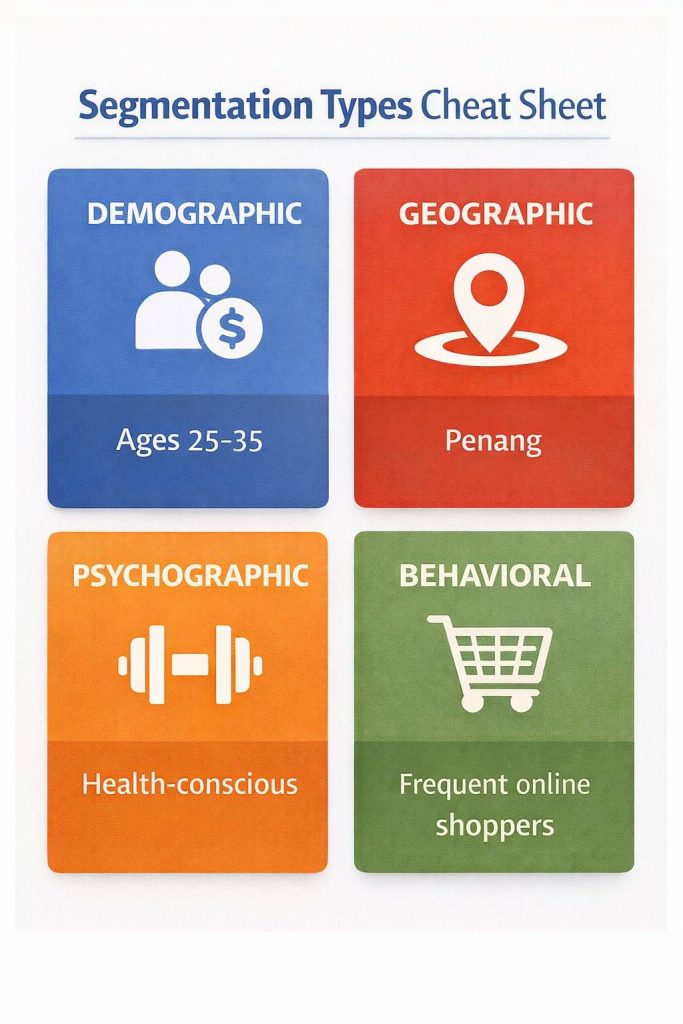
Most brands use a mix of demographic, geographic, psychographic, and behavioural segmentation.
Segmentation allows brands to design messaging that resonates with specific audiences.
Step 4: Build Customer Personas
Customer personas translate research data into realistic audience profiles.
Typical persona elements include:
- Age and occupation
- Lifestyle and interests
- Goals and motivations
- Pain points or frustrations
- Preferred communication channels
Personas help marketing teams visualise the type of person they are communicating with and guide content development.
Step 5: Test Your Audience Assumptions
Many brands initially rely on assumptions when defining their audience. Testing helps confirm whether those assumptions are correct.
Testing methods include:
- Small digital advertising campaigns
- Landing page experiments
- Social media engagement tests
- Content performance analysis
These experiments reveal which audience segments respond most positively. Controlled social ad testing is a widely used approach for comparing how different messages and creatives influence response (Source: NCBI/PMC, 2021).
Step 6: Refine Audience Insights Over Time
Audience identification is an ongoing process rather than a one-time activity.
Brands should regularly review:
- Website analytics
- Campaign performance
- Conversion rates
- Customer feedback
Continuous improvement ensures the target audience definition remains accurate as the business grows.
Common Challenges Malaysian Brands Face
Even with structured frameworks, identifying a target audience can present several challenges:
- Targeting too broadly: Generic messaging weakens differentiation.
- Limited data for startups: Lack of history makes analysis harder; start with interviews and small tests.
- Overreliance on demographics: Demographics rarely explain why people buy; motivations matter.
- Rapid changes in digital behaviour: Short-form video and social commerce patterns shift quickly, so assumptions need frequent updates.
Typical Costs Of Audience Research
The cost of identifying a target audience depends on the research methods used.
Research Method | Typical Cost Range |
Online surveys | Low |
Social media analytics | Low |
Market research reports | Medium |
Focus groups | Medium to high |
Professional market research agencies | High |
Many Malaysian startups begin with low-cost research methods before investing in more comprehensive studies.
Example: Identifying A Target Audience For A Malaysian Brand
Consider a Malaysian fitness supplement brand launching a new product.
Instead of targeting everyone interested in health, the company could focus on a more specific segment.
Audience Segment | Key Characteristics |
Young professionals | Ages 25–35 living in urban areas |
Fitness enthusiasts | Regular gym-goers |
Social media users | Active on TikTok and Instagram |
By narrowing its focus, the brand can design marketing campaigns, content, and messaging that resonate more strongly with its ideal customers.
Choosing the Right Target Audience
Identifying a target audience is one of the most important steps when launching or rebranding a business. When Malaysian brands clearly understand who their customers are, they can build stronger messaging, develop better products, and allocate marketing resources more effectively.
If your business is preparing to reposition its brand or reach new audiences, working with experienced PR professionals can help refine your messaging and market positioning. PRESS PR Agency supports Malaysian brands through strategic PR services that strengthen credibility, increase visibility, and connect businesses with the audiences that matter most.
Disclaimer: This article is for general informational purposes only and does not constitute legal, financial, or professional advice. Always verify platform data, market conditions, and compliance requirements (including PDPA) for your specific business, and consult qualified professionals where needed.