

Greenwashing may generate positive attention in the short term, but the consequences can be serious when investors or stakeholders discover that a company’s environmental claims are inaccurate, incomplete or misleading.
Sustainability is becoming increasingly important to Malaysian investors, customers, employees and business partners. Companies now regularly promote carbon-reduction plans, renewable energy use, sustainable products and environmental, social and governance initiatives. These efforts can strengthen a company’s reputation and attract investment.
However, sustainability messaging becomes a liability when a company says more than it can prove.
For Malaysian listed companies, this is more than a public relations risk. Misleading sustainability statements may also raise compliance concerns under Bursa Malaysia’s Main or ACE Market Listing Requirements.
What Is Greenwashing?
Greenwashing is the use of environmental messaging that makes a company, product or activity appear more sustainable than it really is.
It can include:
- Calling a product “green” or “eco-friendly” without defining those terms.
- Promoting a small environmental initiative while ignoring larger negative impacts.
- Claiming carbon neutrality without a credible calculation or methodology.
- Announcing a net-zero target without milestones or an implementation plan.
- Using nature-themed packaging or labels that resemble official certifications.
- Publishing sustainability figures that cannot be verified.
Greenwashing does not always involve an entirely false statement. A claim may also be misleading because it lacks context, omits important information or exaggerates the company’s environmental performance.
Why Greenwashing Is Dangerous for Malaysian Businesses
Investors May Question Other Company Disclosures
Investors rely on corporate disclosures to assess business risks, growth opportunities and management quality. Sustainability information increasingly forms part of that assessment, particularly when environmental issues affect costs, supply chains, financing or regulation.
When one environmental claim is exposed as misleading, investors may begin questioning the reliability of the company’s other statements.
The damage can extend beyond the sustainability report. Investors may lose confidence in management forecasts, risk assessments, governance controls and financial disclosures.
Access to Capital May Become More Difficult
Businesses seeking investment, sustainability-linked financing or strategic partnerships are increasingly expected to provide reliable ESG information.
A company associated with greenwashing may face:
- More extensive due diligence.
- Additional requests for evidence.
- Greater scrutiny from lenders and institutional investors.
- Difficulty qualifying for sustainability-linked financing.
- Higher legal, assurance and compliance costs.
- Reduced interest from responsible investment funds.
The effect on market value will depend on the seriousness of the allegation and the company involved. However, the wider concern is that investors may no longer trust the information used to assess the company’s risks and opportunities.
Customers, Employees and Partners May Feel Misled
Environmental claims are also used to attract customers, employees, distributors and commercial partners.
When those claims are challenged, stakeholders may feel that the company has taken advantage of their environmental concerns.
Possible consequences include:
- Customer complaints and negative reviews.
- Social media criticism.
- Loss of employee confidence.
- Difficulty attracting sustainability-conscious talent.
- Strained relationships with suppliers and partners.
- Increased scrutiny from journalists and regulators.
Unlike an ordinary marketing mistake, greenwashing can raise broader questions about a company’s honesty and corporate culture.
Genuine Sustainability Work May Lose Credibility
Greenwashing can also undermine real environmental improvements.
A business may have reduced electricity consumption or improved waste management. However, if it describes the whole organisation as “carbon-free” without sufficient evidence, stakeholders may dismiss all its sustainability efforts once the claim is challenged.
Sustainability communication should reflect actual progress rather than present an unfinished journey as a completed transformation.
Bursa Malaysia’s Position on Misleading Disclosures
Bursa Malaysia’s Listing Requirements do not create a separate offence specifically called “greenwashing”.
However, greenwashing in an announcement, circular, annual report or Sustainability Statement may fall within the broader rules governing inaccurate, incomplete or misleading disclosures.
Public Information Must Be Accurate and Balanced
Paragraph 9.17 of the Main Market Listing Requirements and Rule 9.17 of the ACE Market Listing Requirements govern the preparation of public announcements and circulars.
Information provided by a listed issuer must be factual, clear, unambiguous and accurate. It must not be false, misleading or deceptive, and it should present information fairly and in a balanced manner.
These principles are directly relevant to sustainability claims.
A disclosure may create compliance concerns when it:
- Overstates emissions reductions.
- Omits an important limitation in the company’s data.
- Presents a target as though it has already been achieved.
- Uses a selective reporting boundary to produce a favourable result.
- Describes a project as sustainable without explaining the criteria.
- Publishes inconsistent ESG figures across reports or announcements.
Even a technically correct statement may be misleading if important context has been left out.
Sustainability Statements Are Reporting Obligations
Main and ACE Market listed issuers are required to include a Sustainability Statement in their annual reports.
Malaysia’s National Sustainability Reporting Framework is also introducing the IFRS Sustainability Disclosure Standards in phases:
- Main Market issuers with a market capitalisation of RM2 billion and above began applying the framework for annual reporting periods beginning in 2025.
- Other Main Market issuers follow from 2026.
- ACE Market issuers follow from 2027.
The framework is intended to improve the consistency, comparability and reliability of sustainability information provided to investors.
As these requirements develop, companies will need stronger systems for collecting data, approving disclosures and connecting sustainability risks with financial performance.
Bursa Malaysia Can Impose Serious Penalties
Bursa Malaysia may take enforcement action against listed issuers and directors for breaches of its Listing Requirements, including breaches involving inaccurate, delayed or misleading disclosures.
Available sanctions under the Main and ACE Market Listing Requirements include:
- Private or public reprimands.
- A fine of up to RM1 million.
- Directions requiring corrective action.
- Trading suspension.
- Delisting in serious circumstances.
The sanction will depend on the facts, the responsible party and the seriousness of the breach. Directors and other individuals may also face action where their conduct contributed to the violation.
This does not mean every inaccurate environmental statement will result in the maximum penalty. It does mean that listed companies should not treat sustainability disclosures as informal promotional material.
Where environmental information appears in an annual report, market announcement or investor presentation, inaccuracies may become a capital-markets compliance issue.
Consumer-Facing Green Claims Carry Risks Too
Non-listed companies are not subject to Bursa Malaysia’s Listing Requirements. However, they should still be careful when making environmental claims to consumers.
Sections 9 and 10 of Malaysia’s Consumer Protection Act 1999 address misleading conduct and false or misleading representations concerning goods and services.
These provisions may be relevant where an environmental claim misleads consumers about a product’s characteristics, composition, manufacturing process or benefits.
Companies should therefore be able to substantiate statements such as:
- “Made from 100% recycled material.”
- “Biodegradable.”
- “Zero emissions.”
- “Carbon-neutral.”
- “Environmentally safe.”
- “The most sustainable option.”
The broader or more absolute the statement, the stronger the supporting evidence should be.
Common Greenwashing Risks for Malaysian Companies
Risky practice | Why stakeholders may be misled |
Using “eco-friendly” without a definition | The environmental benefit is unclear |
Announcing net-zero ambitions without milestones | A distant target may create an impression of action without current progress |
Highlighting recyclable packaging alone | It may distract from emissions, sourcing or waste elsewhere |
Using a self-created green logo | Consumers may mistake it for an independent certification |
Reporting only selected facilities | The figures may not represent the full business |
Making claims without a baseline year | Stakeholders cannot assess the improvement |
Relying heavily on offsets without explanation | The claim may hide actual operational emissions |
Publishing inconsistent figures | Differences create doubts about data quality and controls |
How Malaysian Businesses Can Avoid Greenwashing
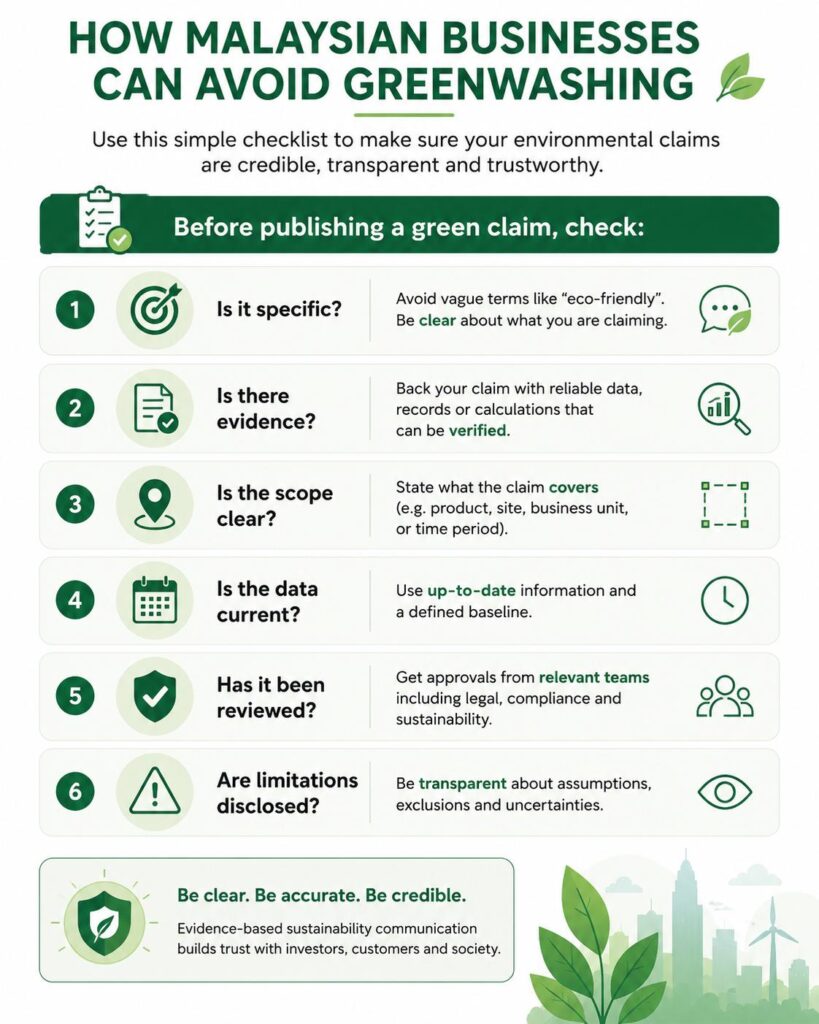
Treat Sustainability Claims as Verifiable Statements
Before publishing an environmental claim, the company should be able to explain:
- What exactly is being claimed?
- Which product, activity or location does it cover?
- What period does it apply to?
- What is the baseline?
- How was the result calculated?
- What evidence supports it?
- What limitations should be disclosed?
When these questions cannot be answered, the claim may not be ready for publication.
Replace Broad Language With Specific Information
Statements such as “we care for the planet” provide little useful information.
A more credible statement would be:
“Electricity consumption at our Shah Alam facility fell by 12% between 2024 and 2025, based on utility records and adjusted for changes in operating hours.”
This identifies the metric, location, period and basis of comparison.
Maintain a Sustainability Claims Register
Companies should keep a central record of claims used in annual reports, Bursa announcements, investor presentations, websites, product packaging, sales materials and press releases.
For each claim, the register should identify its owner, evidence, calculation method, approval status and review date.
This reduces the risk of different departments publishing inconsistent information.
Involve More Than the Marketing Team
Sustainability communication should not be approved solely by marketing or public relations personnel.
Depending on the claim, the review process may require input from operations, finance, procurement, legal, compliance, internal audit, sustainability specialists and the board.
The people responsible for the underlying activity should confirm that the public statement reflects what is happening in practice.
Explain Limitations and Uncertainty
Businesses do not need to present themselves as environmentally perfect.
Stakeholders are more likely to trust a company that clearly explains where data is incomplete, which operations are excluded, which targets depend on future investment and whether results have been independently assured.
Consider Independent Verification
External assurance, recognised certifications and specialist reviews can strengthen important environmental claims.
However, the scope of verification should be explained. A review of one emissions figure should not be presented as independent validation of the company’s entire sustainability strategy.
Correct Mistakes Quickly
When a company discovers that a sustainability statement is inaccurate, it should assess and correct the issue promptly.
For listed issuers, this may require consultation with legal advisers, the company secretary, the board and compliance professionals to determine whether a further market disclosure is necessary.
Greenwashing Is a Governance Issue
Greenwashing is sometimes treated as a problem caused by overenthusiastic advertising. In reality, it may point to wider weaknesses in governance.
It can indicate that:
- Sustainability data is not properly controlled.
- Departments use different definitions.
- Environmental targets are not connected to operational plans.
- The board has insufficient oversight.
- Public statements are approved without adequate evidence.
- Business strategy and sustainability messaging are not aligned.
These weaknesses matter to investors because they reflect the quality of management and internal controls.
Greenwashing and Your Business
Greenwashing may appear to offer a quick reputational advantage, but that advantage can disappear as soon as investors or stakeholders ask for evidence.
For Malaysian businesses, the consequences may include damaged trust, greater due diligence, lost commercial opportunities, regulatory scrutiny and expensive corrective work.
For companies listed on Bursa Malaysia, misleading sustainability information may also engage the disclosure and enforcement provisions of the Main or ACE Market Listing Requirements.
Businesses that communicate honestly about their achievements, limitations and future plans will be better positioned to earn long-term confidence from investors, customers, employees and commercial partners.
PRESS PR Agency helps Malaysian organisations develop clear and credible sustainability communications that reflect their actual progress. Our team combines local market knowledge with ESG and communications practices to help companies avoid vague, exaggerated or unsupported claims.
Disclaimer: This article is for general information only and does not constitute legal, investment, financial or regulatory advice.
Sources
- Bursa Malaysia Main Market Listing Requirements, Chapter 9: Continuing Disclosure.
- Bursa Malaysia Main Market Listing Requirements, Chapter 16: Enforcement.
- Bursa Malaysia, Sustainability Reporting Requirements and related guidance.
- Advisory Committee on Sustainability Reporting, National Sustainability Reporting Framework.
- Securities Commission Malaysia, Sustainable and Responsible Investment Taxonomy.
- International Organization of Securities Commissions, Supervisory Practices to Address Greenwashing.
- European Securities and Markets Authority, research on the financial impact of greenwashing controversies.
- Consumer Protection Act 1999, Malaysia.