Key Takeaway
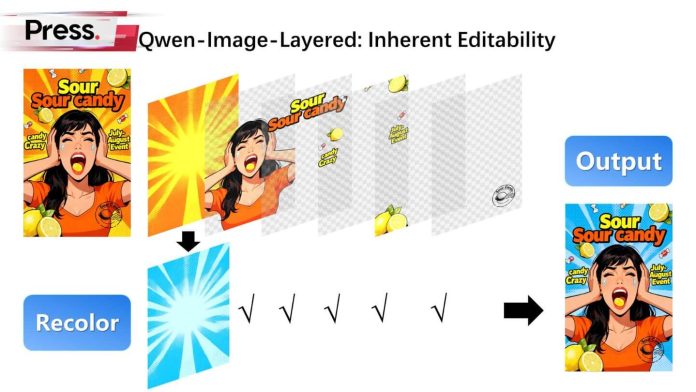
- Qwen Image Layered automatically decomposes flat images into 3–8+ fully editable RGBA layers with transparency.
- Unlike basic segmentation, it intelligently inpaints hidden backgrounds to prevent empty “holes” behind moved objects.
- The model utilizes recursive decomposition to refine complex elements, offering superior edge detection over older tools.
- It bridges the gap between text-to-image generation and professional editing by outputting Photoshop-ready layer stacks.
- Designers can now isolate, resize, and recolor specific elements without destructive editing or manual pen-tool work.
Table of Contents
ToggleWhat Is Qwen Image Layered and How Does It Change Design?
Qwen Image Layered is an open-source AI model released by Alibaba Cloud that automatically separates a single flat image into multiple, semantically distinct editable layers.
Unlike traditional background removers that leave gaps, Qwen reconstructs the hidden areas behind objects (inpainting) and generates transparency channels (alpha) for every element.
This allows users to move, resize, or delete objects immediately, simulating a native Photoshop file structure from a standard JPEG or PNG input.
If you have ever spent hours manually masking hair or complex edges in Photoshop, you know the pain of destructive editing.
Qwen Image Layered solves this by treating every generated image as a stack of independent assets rather than a single canvas.
By automating the “cutting out” process and simultaneously filling in the background, it creates what researchers call “inherent editability”—effectively handing you a project file instead of just a picture.
🧾 Feature Comparison: Qwen vs. Standard Tools
Feature | Qwen Image Layered | Segment Anything (SAM) | Manual Photoshop Editing |
Output Type | Full RGBA Layer Stack | Binary Masks (Selection) | Editable Layers (PSD) |
Background Fill | Auto-Inpainted (No holes) | None (Leaves holes) | Manual (Content-Aware Fill) |
Edge Quality | High (Handles transparency) | High (Binary edges) | Perfect (Depends on skill) |
Speed | Seconds | Seconds | Minutes to Hours |
Editability | Immediate (Move/Resize) | Requires Masking | Full Control |
How Does Qwen Image Layered Actually Work?
It uses a specialized “Variable Layers Decomposition” architecture to predict what lies behind the foreground.
Qwen Image Layered isn’t just looking at outlines; it is understanding the semantic structure of an image. When you feed it a picture, it identifies the “Subject,” the “Background,” and secondary elements like “Text” or “Decorations.”
It then uses a process called RGBA-VAE (Variational Autoencoder) to generate not just the color pixels (RGB) but also the transparency map (Alpha) for each distinct layer.
- Recursive Refinement: If an image is complex, the model can apply recursive decomposition. It breaks the image down into primary layers first, then analyzes those layers to see if they can be split further.
- Occlusion Handling: This is the technical magic. If a person is standing in front of a car, Qwen generates the person on Layer 1 and the entire car on Layer 2—reconstructing the parts of the car blocked by the person so you can move the person aside without seeing a blank space.
Expert Insight: “The leap here isn’t just selection—it’s reconstruction. Qwen gives us the pixels we couldn’t see, effectively hallucinating the missing data to make the layer usable.”
Will This Technology Replace Manual Photoshop Masking?
It will likely eliminate 80% of routine masking tasks, shifting the designer’s role from technician to compositor.
For years, the “Pen Tool” was the badge of honor for graphic designers. Qwen Image Layered threatens to make that skill largely redundant for standard commercial work.
By automating the extraction of subjects with near-perfect transparency preservation (like hair or glass), it removes the bottleneck of asset preparation.
However, it is not a complete replacement yet. While Qwen is exceptional at decomposition, human judgment is still required for artistic compositing and final color grading. The impact is speed: what took an hour of deep-etching now takes seconds of processing.
- Workflow Shift: Designers will spend less time cutting out products and more time iterating on layouts.
- Accessibility: Non-designers can now manipulate complex images without knowing how to use selection channels.
How Can Agencies Leverage Layered AI for Growth?
Agencies can produce reactive content and campaign variations at triple the speed of traditional workflows.
In the fast-paced world of digital marketing, the ability to repurpose a single key visual into multiple formats (Instagram Story, Banner, Thumbnail) is crucial.
Qwen allows creative teams to generate one high-quality image and immediately break it apart to rearrange elements for different aspect ratios without quality loss.
For a specialized PR Agency Malaysia, this efficiency is vital. Instead of waiting days for a designer to manually separate assets for a press kit the team can generate editable layers instantly.
What Are the Current Limitations of Layered Generation?
Resolution limits and occasional “hallucinations” in background reconstruction remain the primary hurdles.
While impressive, Qwen Image Layered is effectively “guessing” what is behind an object. In 90% of cases, this inpainting is accurate enough for social media or web use.
However, for high-resolution print advertising, the reconstructed details might lack the sharpness of a real photograph.
- Artifacting: You may notice slight blurring or illogical textures in the inpainted background areas once the foreground is moved.
- Hardware Intensity: Running these models locally requires significant VRAM (often 24GB+ for high performance), making it less accessible to casual users without cloud-based interfaces.
Still relying on flat images?
The future of design is modular. Start experimenting with layered AI to future-proof your workflow.
Conclusion
Qwen Image Layered represents a massive shift in how we interact with digital images. By moving from “flat pixels” to “semantic layers,” it unlocks a level of control that was previously exclusive to skilled Photoshop users.
While it won’t replace the creative eye of a senior designer, it renders the tedious task of manual masking obsolete.
Adopting this workflow allows creators, marketers, and agencies to dedicate more time to creative execution and less to technical fixes.
Interested in more AI knowledge? Explore our Top 10 AI Automation Tools for Malaysian Businesses (2026) guide to benefit your business.
Frequently Asked Questions About Qwen Image Layered & AI Editing
Is Qwen Image Layered free to use?
Yes, Qwen Image Layered is an open-source model available on platforms like Hugging Face. You can run it locally if you have powerful hardware or access it through various cloud-hosted AI demos.
Can Qwen export directly to Photoshop PSD files?
Technically, the model outputs separate RGBA image files (PNGs). However, many community-built scripts and plugins can now automatically stack these output images into a standard PSD file for immediate use.
How is this different from Adobe’s Generative Fill?
Adobe Generative Fill modifies a specific area within a flat image. Qwen Image Layered deconstructs the entire image into independent layers at once, giving you total control over every element simultaneously.
Does Qwen Image Layered work on existing photos?
Yes. While it is powerful for generating new layered images from text, you can also input an existing photograph, and it will attempt to decompose it into editable layers with inpainted backgrounds.
What hardware do I need to run this locally?
To run Qwen Image Layered efficiently on your own machine, you typically need a GPU with at least 16GB to 24GB of VRAM, such as an NVIDIA RTX 3090 or 4090.
Is the background reconstruction always accurate?
It is highly accurate for general contexts (sky, walls, nature). However, if the background has complex, specific text or intricate mechanical details hidden behind the subject, the AI might generate a plausible but incorrect guess.