

Many global brands assume successful campaigns can be reused across markets. In reality, messaging that works in Western markets or even other Asian countries may not resonate in Malaysia.
Malaysia is multicultural and multilingual, and consumer behavior is shaped by culture, religion, language, and social trends. Marketing messages that reflect local experiences, cultural moments, and familiar communication styles tend to perform far better.
Malaysia’s internet usage is extremely high (98.0% of individuals used the internet in 2024) and the market is strongly mobile-led. That creates a digital environment where culturally relevant messaging spreads quickly through social platforms and online communities.
(Source: Department of Statistics Malaysia (DOSM), ICT Use and Access by Individuals and Households Survey Report 2024, published 24 April 2025)
Read More: Intercultural communication for PR
What Does Malaysia Brand Localization Actually Mean?
Brand localization means adapting your messaging, branding, and marketing strategy to fit a specific market while maintaining overall brand consistency.
For global brands entering Malaysia, localization typically includes:
Localization elements
- Language: Adapting tone and vocabulary (e.g., English mixed with Bahasa Malaysia depending on audience)
- Cultural context: Reflecting local values and traditions (e.g., Ramadan campaigns)
- Visual identity: Adjusting imagery and symbolism (e.g., family-oriented festive visuals)
- Digital platforms: Using the channels Malaysians actually use (e.g., TikTok, Shopee)
- Product adaptation: Adjusting features or offerings (e.g., halal-certified products where relevant)
Localization helps international brands feel “made for Malaysia” without losing their global identity.
Why Malaysia Is a Unique Market for Global Brands
Multicultural consumer segments
Malaysia includes several major communities including Malays, Chinese, Indians, and indigenous groups. Each has different cultural traditions, purchasing patterns, and festive celebrations. Marketing strategies that recognize these differences often achieve stronger engagement.
Language diversity (and why tone matters)
Malaysia uses a mixture of languages in everyday communication. Brands commonly use:
- Bahasa Malaysia for national messaging
- English for urban and professional audiences
- Mandarin or Tamil for targeted community campaigns
Many casual campaigns also incorporate Manglish (a blend of English and Malay conversational expressions). It can work, but only when it sounds natural and not forced.
Cultural and religious sensitivities
Malaysia’s Muslim-majority audience means cultural awareness matters, especially for:
- Food & beverage and personal care: halal status can strongly influence trust and purchase decisions
- Ramadan and Hari Raya messaging: tone should be respectful and values-led
- Creative execution: visuals, greetings, and humor need local context
If you want a simple rule: avoid “global templates” during sensitive cultural periods; Malaysia audiences notice immediately.
Social commerce and mobile usage
Malaysia is highly digital and mobile-driven. People frequently discover products through social content and complete purchases through marketplace listings and chat-based coordination.
That’s why localization needs to cover the full journey, not just ads.
Who Should Be Involved in Localization?
Localization works best when multiple stakeholders are involved:
- Local marketing teams who understand cultural nuance
- PR agencies familiar with the Malaysian media landscape
- Digital strategists who understand local platform behavior
- Influencers who communicate authentically with audiences
- Legal or compliance advisors (especially for regulated categories)
Combining global strategy with local insight reduces the risk of cultural missteps and improves performance.
When Should Global Brands Localize Their Message?
Localization should start before market entry.
Brands that wait until after launching often need expensive revisions to messaging, visuals, and customer comms. Localization is especially important when:
- Entering a new market
- Launching new products
- Expanding to new audiences
- Running festive campaigns
Major Malaysian campaign periods (high opportunity moments)
- Chinese New Year: family promotions and reunion themes
- Ramadan & Hari Raya: food, retail, lifestyle, and community storytelling
- Deepavali: cultural storytelling and celebration themes
- Merdeka Day: national pride and unity themes
Where Localization Happens in the Customer Journey
Localization influences multiple brand touchpoints. Common areas include:
- Website content and landing pages
- Social media messaging
- Paid ads (copy + visuals)
- Influencer collaborations
- Customer support and chat scripts
- E-commerce listings (titles, images, FAQs, reviews strategy)
Each interaction shapes how Malaysian consumers perceive your brand.
How Global Brands Can Localize Messaging in Malaysia (Step-by-Step)
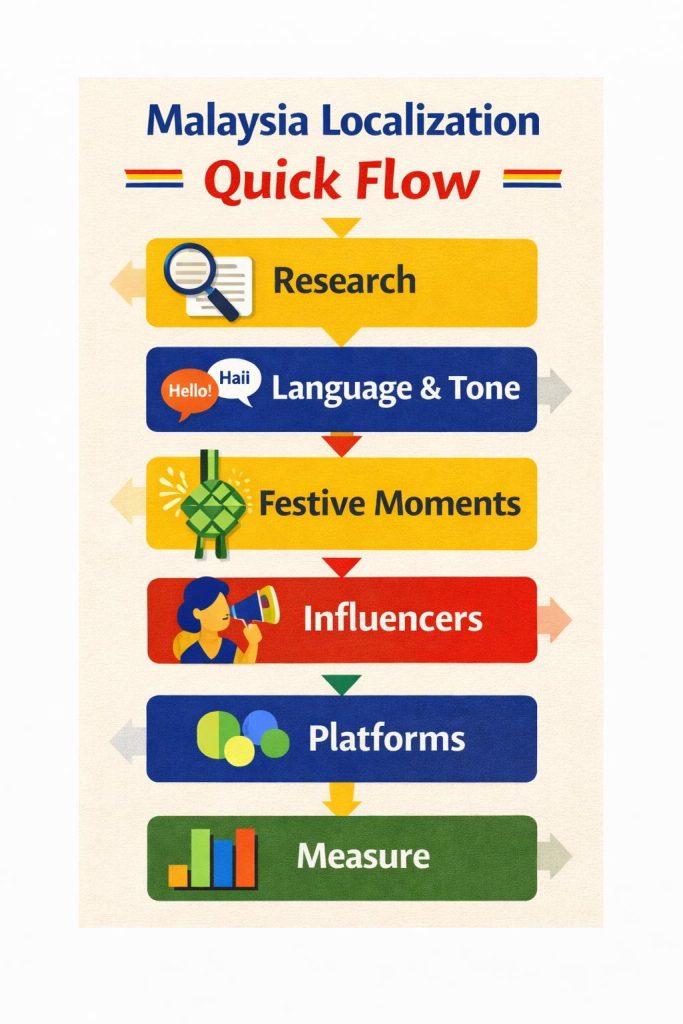
Step 1: Conduct cultural market research
Effective localization begins with understanding the audience. Research should examine:
- Cultural values
- Consumer behavior and purchase triggers
- Local competitors and category norms
- Festive calendars and seasonal peaks
Also remember: Malaysia has strong local competition. MSMEs contributed 39.5% of GDP in 2024, reflecting the scale of local businesses global brands compete with. (Source: Department of Statistics Malaysia (DOSM), Micro, Small & Medium Enterprises (MSMEs) Performance 2024, published 31 July 2025)
Skimmable research checklist
- What does “value” mean in this category (price, quality, trust, convenience)?
- What language mix is normal for this audience?
- What is culturally “safe” vs “risky” in humor, visuals, and phrasing?
- What do competitor listings look like on Shopee/Lazada (images, claims, bundles)?
Step 2: Adapt language and tone (not just translation)
Malaysian consumers often respond well to conversational, relatable messaging. But it must still sound credible.
- Use friendly clarity (especially for Bahasa Malaysia)
- Avoid over-localizing with slang if the Malaysia brand voice is premium or formal
- Don’t translate word-for-word; translate intent
Small example: “Global slogan” → localized intent
- Global: “Unleash your potential.”
- Malaysia-friendly (corporate): “Bina keyakinan, capai lebih.”
- Malaysia-friendly (youth): “Let’s naik level, tapi still you.”
The message stays consistent for the general market, but the tone fits the audience.
Step 3: Align campaigns with cultural moments
Festive marketing is especially powerful in Malaysia.
Many Ramadan campaigns highlight generosity, family, and community because those themes align with lived experiences and values.
Small example: one product, two festive storylines
- Ramadan/Hari Raya: togetherness, gifting, sharing, balik kampung readiness
- Chinese New Year: reunion meals, prosperity cues, visiting rituals
Same product. Different emotional hook.
Step 4: Collaborate with local influencers (for trust and realism)
Influencers and creators play a major role in Malaysia marketing. They help brands:
- Communicate naturally with audiences
- Build credibility quickly
- Demonstrate products authentically
- Pressure-test “global creative” before it goes live
Practical move: Let creators rewrite your script in their own words, then review for Malaysia brand safety instead of forcing a global template.
Step 5: Adapt digital marketing channels (mobile-first execution)
Malaysia’s digital behavior rewards brands that build for fast attention and easy checkout.
A recent Malaysia coverage report noted Malaysians spend around eight hours a day online, making platform-first creative and mobile execution especially important. (Source: New Straits Times, report published 28 October 2025, citing regional internet-use comparisons)
What “mobile-first” should look like in practice
- Shorter copy, faster hooks (first 1–2 seconds matter on TikTok/Reels)
- Marketplace-ready creative: clear thumbnails, simple benefits, strong bundles
- Click paths that reduce friction (tap → listing → buy)
- Customer support scripts that match local expectations (polite, clear, responsive)
Read More: How to build Industry Authority Through Opinion Columns
Small example: TikTok vs Shopee copy (same promo)
- TikTok: “Raya prep made easy – satu set settle ✅”
- Shopee listing: “Set Persediaan Raya (Bundle Jimat) | Fast Delivery | Ready Stock”
Same idea, different platform language.
Step 6: Maintain core brand identity
Localization should not erase your global identity. Strong localization keeps:
- Consistent brand voice (even if phrasing changes)
- Recognizable visual identity
- Unified brand values
Think of localization as tuning, not transforming.
A 2026 Localization Checklist: Compliance, Representation, and Trust
Malaysia localization isn’t just about tone, it’s also about avoiding unforced errors that can damage trust fast. For global brands, a simple checklist helps teams move quicker while staying culturally safe.
1) Build compliance into creative reviews (not just legal sign-off)
- Malaysia’s advertising ecosystem expects responsible messaging, especially around sensitive themes like religion, family, and personal identity.
- Use a structured approval flow for: visuals, taglines, influencer scripts, and comment moderation.
- When in doubt, benchmark against the Advertising Standards Malaysia Codes and local platform policies, then adapt to your category. (Source: Advertising Standards Authority Malaysia (ASA), The Malaysian Code of Advertising Practice / List of Codes, accessed 2026)
2) Treat halal as a trust signal, not a decorative label
If you operate in F&B, cosmetics, or personal care, consumers often interpret halal status as a proxy for brand credibility and product assurance. Align product pages, packaging claims, FAQs, and influencer talking points so the story stays consistent across marketplaces, social content, and support.
3) Localize representation across Malaysia, not only Klang Valley
Malaysia is multicultural and regionally diverse. Casting, settings, and language often land differently between urban and non-urban audiences, and across West/East Malaysia. “Local” should look and feel believable.
4) Translate intent, not words
Direct translation can accidentally change meaning or politeness level. Use native writers for key campaigns. If you use Manglish, treat it like seasoning: too much reads as try-hard.
5) Design for mobile commerce behavior
Malaysia’s internet usage is near-universal, and shopping journeys often start with social content and end on marketplace listings. Make your experience genuinely mobile-first: fast pages, simple benefits, and clear purchase paths.
(Source: Department of Statistics Malaysia (DOSM), ICT Use and Access by Individuals and Households Survey Report 2024, published 24 April 2025)
6) Measure localization with the right KPIs
Don’t judge localization only on reach. Add “trust and intent” signals:
- Saves/shares
- Comment sentiment
- Add-to-cart rate
- Conversion from influencer links
- Customer service resolution time
The goal is not to look local, it’s to perform local.
Quick “Do / Don’t” Box for Malaysia Localization
Do
- Use culturally appropriate greetings and visuals during Ramadan/Raya and CNY
- Let creators speak naturally (then review for safety and accuracy)
- Keep listings and landing pages localized, not just ads
- Use Bahasa Malaysia clearly for broad reach (especially mass-market categories)
- Set a review process for sensitive seasons and regulated categories (Source: Advertising Standards Authority Malaysia (ASA), The Malaysian Code of Advertising Practice / List of Codes, accessed 2026)
Don’t
- Copy-paste a “regional Asia” campaign and swap the language only
- Overuse slang/Manglish if it doesn’t match your brand voice
- Use generic festive imagery that clashes with local expectations
- Assume platform strategy is the same as Singapore/Indonesia/Thailand
- Let influencer scripts go live without brand safety checks
Case Studies: Brands That Localize Successfully in Malaysia
McDonald’s Prosperity Burger (Chinese New Year)
McDonald’s Malaysia releases the Prosperity Burger around Chinese New Year. This limited-time item reflects local festive traditions and has become an anticipated annual campaign.
Grab Ramadan campaigns
Grab frequently launches Ramadan-themed advertising focused on generosity and community, aligning with what audiences expect during the season.
Shopee mega sale campaigns
Shopee’s major sales campaigns often feature local celebrities, humor, and festive storytelling tailored to Malaysian audiences, showing how local cultural cues can drive engagement.
Challenges Global Brands Face When Localizing
Localization offers strong advantages but introduces real challenges:
- Cultural misunderstandings
- Translation errors and tone mismatches
- Inconsistent brand voice across languages
- Compliance concerns (especially regulated categories)
- Fragmented messaging across platforms
Without local expertise, brands may struggle to balance authenticity with consistency.
What Does Localization Cost?
Localization costs vary depending on scope and strategy:
Typical investment levels
- Market research: Moderate
- Translation and copy adaptation: Low to moderate
- Influencer partnerships: Moderate to high
- Cultural campaign development: Moderate
- Full localization strategy: High
Localization requires investment, but poor localization can cost more in reputation and lost engagement.
Localization Builds Trust in Malaysia
Malaysia’s diverse culture and digital-first audience mean global brands can’t rely on one-size-fits-all marketing. Brands that invest in localization earn stronger engagement, cultural relevance, and long-term credibility.
For international companies navigating Malaysia’s media landscape, PRESS PR Agency helps global brands adapt messaging and storytelling to local audiences through strategic PR campaigns, combining international brand expertise with local market insight to build trust and visibility in Malaysia. Get in touch with PRESS today to start your journey in the Malaysian market well!