

If you’re a student trying to decide between MUET and IELTS, the good news is that there isn’t a wrong answer. The better question is which test aligns with your future plans.
For Malaysian students, both exams serve the same fundamental purpose: proving English language proficiency. However, they are designed for different pathways. MUET primarily supports higher education within Malaysia, while IELTS is recognised by universities, employers, immigration authorities, and professional bodies worldwide.
Many students automatically assume IELTS is the better option because it is internationally recognised. Others choose MUET because it is considerably cheaper. In reality, the best choice depends on where you plan to study, work, and potentially live in the future.
Before spending time and money preparing for either exam, it is worth understanding what each test offers and how they compare in practical terms.
MUET vs IELTS Comparison Table
| Factor | MUET | IELTS |
|---|---|---|
| Full Name | Malaysian University English Test | International English Language Testing System |
| Primary Purpose | Malaysian higher education | International study, work, migration |
| Recognition | Mainly Malaysia | Worldwide |
| Test Provider | Malaysian Examinations Council (MPM) | British Council, IDP IELTS, Cambridge University Press & Assessment |
| Validity Period | 5 years (MPM validity policy) | Typically 2 years (varies by organisation) |
| Approximate Cost (Malaysia) | RM150 (citizen fee; different fee for non-citizens) | Commonly RM960 for IELTS Academic/General; UKVI/variants differ |
| Speaking Format | Group setting (2–4), with individual task + group interaction | One-on-one interview with examiner |
| Test Frequency | Scheduled national sessions + MUET on Demand (MoD) available | Multiple sessions throughout the year |
| Overseas University Acceptance | Limited | Extensive |
| Migration Applications | Generally not accepted | Widely accepted |
What Is MUET?
MUET is Malaysia’s national English proficiency examination designed primarily for higher education admission.
Administered by the Malaysian Examinations Council (MPM), MUET assesses a student’s ability to use English in academic settings. The test covers listening, speaking, reading, and writing: the same four language skills assessed in IELTS.
MUET is commonly taken by students in Form 6, matriculation, foundation programmes, and diploma pathways. Public universities often require a minimum MUET band score for admission or graduation, depending on the programme.
One reason MUET remains popular is its affordability. For many students, it provides a recognised English qualification without the significantly higher costs associated with international examinations.
What Is IELTS?
IELTS is one of the world’s most widely recognised English language proficiency examinations.
IELTS is jointly owned and delivered through a partnership involving the British Council, IDP IELTS, and Cambridge University Press & Assessment. It is recognised by thousands of institutions globally, including universities, employers, professional bodies, and governments.
Students often take IELTS for reasons such as:
- Applying to overseas universities
- Securing international scholarships
- Meeting immigration requirements
- Pursuing professional registration abroad
- Expanding future career opportunities
Unlike MUET, IELTS is not tied to any one country’s education system. Its global acceptance is arguably its biggest advantage.
Read More: Public vs Private University in Malaysia: 2026 Student Guide
Recognition and Acceptance: Local vs Global
The biggest difference between MUET and IELTS is where each qualification is recognised.
MUET was created specifically to support Malaysia’s education system. As a result, it enjoys widespread acceptance among local public universities and many private institutions.
IELTS, meanwhile, functions as an international standard. Universities in the United Kingdom, Australia, New Zealand, Canada, and many other countries commonly require IELTS scores from international applicants. IELTS is also widely used for professional licensing and migration pathways where English proof is mandatory.
Which Test Fits Your Goals?
| Goal | Better Option |
|---|---|
| Public university admission in Malaysia | MUET |
| Private university in Malaysia | Either may work |
| Study abroad | IELTS |
| Migration application | IELTS |
| International career opportunities | IELTS |
| Local employment | Usually MUET is sufficient |
For students who know they will remain within Malaysia’s education system, MUET often provides everything they need. Students with international ambitions may find IELTS offers greater long-term flexibility.
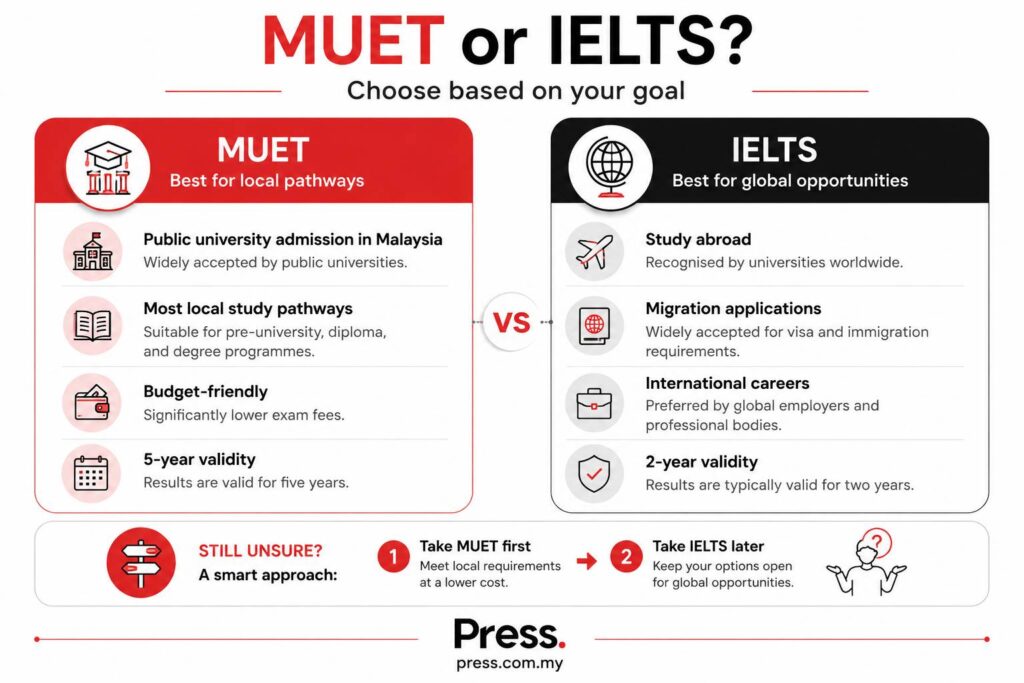
Comparing the Test Structure
At first glance, MUET and IELTS appear very similar because both assess the same four language skills. However, the testing experience differs in several important ways.
Listening
Both examinations assess your ability to understand spoken English.
MUET listening tasks are generally designed around academic and practical situations familiar to Malaysian candidates.
IELTS listening may expose candidates to a wider variety of accents, including British, Australian, New Zealand, and other international English speakers.
Reading
Reading sections in both examinations require candidates to analyse passages and answer comprehension questions.
The difference lies largely in content. MUET passages often focus on topics relevant to higher education and general knowledge. IELTS reading materials may include more specialised or internationally focused topics, which can increase difficulty for some students.
Writing
Writing is often where candidates notice the biggest differences.
MUET writing focuses heavily on academic communication and structured essay writing.
IELTS requires candidates to complete two writing tasks. One task often involves interpreting visual information such as charts, graphs, or diagrams. The second task requires an argumentative or discussion-based essay.
Students who are comfortable analysing data may adapt well to IELTS. Students who prefer traditional essay writing may find MUET more familiar.
Speaking
The speaking component is one of the most noticeable distinctions.
MUET speaking is conducted in a group setting (typically 2–4 candidates). However, it is not “group discussion only.” It includes an individual speaking task first, followed by group interaction/discussion.
IELTS speaking uses a face-to-face interview format with an examiner. Some students prefer IELTS because they have full control over their performance and are not affected by group dynamics.
Read More: Is Tertiary Education in Malaysia Worth It in 2025?
MUET vs IELTS Pricing
Cost is often one of the first considerations for students and parents.
| Examination | Estimated Cost (Malaysia) |
|---|---|
| MUET | RM150 (citizen fee; different fee applies for non-citizens) |
| IELTS | Commonly RM960 for IELTS Academic/General; UKVI/variants differ |
The difference is substantial. For roughly the cost of one IELTS examination, a student could sit for MUET multiple times.
However, cost alone does not determine value.
Imagine two students:
- Student A plans to enrol in a local public university and pursue a career in Malaysia.
- Student B hopes to study in Australia and eventually apply for skilled migration.
For Student A, MUET may provide excellent value because it fulfils necessary requirements at a fraction of the cost.
For Student B, IELTS becomes more valuable because it unlocks opportunities that MUET generally cannot.
That is why students should evaluate return on investment rather than focusing solely on examination fees.
Which Test Is Harder?
One of the most searched questions online is whether MUET is harder than IELTS.
The honest answer is that there is no universal winner. Difficulty depends largely on the candidate.
Areas Where MUET May Feel Easier
- Lower cost pressure: Students may feel less stressed knowing the exam costs significantly less.
- Familiar context: The examination is designed around Malaysian educational expectations.
- Localised environment: Candidates often feel more comfortable with the testing environment and format.
Areas Where IELTS May Feel Harder
- International standards: Candidates are assessed against global benchmarks.
- Broader exposure: Reading and listening materials may contain less familiar topics, vocabulary, or accents.
- One-on-one speaking test: Some students feel more nervous during direct interviews.
Areas Where IELTS May Feel Easier
Some students actually prefer IELTS. They appreciate having full control during the speaking test and not relying on group dynamics. Others prefer the clear structure of IELTS writing tasks.
Ultimately, preparation matters far more than the name of the examination.
MUET to IELTS Score Comparison (Use as a Benchmark)
Students frequently search for score equivalencies when comparing MUET and IELTS. It is important to understand that there is no single universal “official conversion” that every university uses.
The safest approach is:
- Treat comparisons as benchmarks (not guarantees).
- Confirm requirements with your target university, scholarship provider, immigration agency, or professional body.
Also note: MPM aligns MUET Band 5+ to CEFR C1+ (not C2). That means any chart labelling MUET Band 5+ as “C2” oversimplifies the official band description.
If you want a reference point, some universities publish internal benchmarking tables that compare MUET, IELTS, TOEFL, and CEFR. Use those as guidance, but always verify your actual requirement.
Which Test Should You Take?
If You Want to Study at a Malaysian Public University
MUET is usually the most practical choice. It is recognised locally, affordable, and designed for Malaysian higher education pathways.
If You Want to Study Overseas
IELTS is generally the stronger option. Most overseas universities already list IELTS score requirements in their admissions criteria.
If You Want to Apply for Scholarships
Many international scholarship providers prefer IELTS because it lets them compare applicants using a globally recognised standard.
If You Are Considering Migration
IELTS becomes increasingly valuable. Countries such as Australia, Canada, New Zealand, and the United Kingdom commonly recognise IELTS for immigration purposes.
If You Are Still Unsure About Your Future
Many students choose a hybrid approach: complete MUET during pre-university studies, then sit for IELTS later if international opportunities arise. This minimises upfront costs while preserving future flexibility.
MUET Pros and Cons
Advantages
- Affordable entry cost: Much lower examination fees.
- Strong local recognition: Accepted by most Malaysian universities.
- Longer validity period: Results are valid for five years under MPM policy.
- Familiar academic context: Designed specifically for Malaysian candidates.
Disadvantages
- Limited global recognition: Not widely accepted internationally.
- Fewer career applications abroad: Less useful for migration and overseas employment.
- Restricted international flexibility: May not satisfy international requirements.
IELTS Pros and Cons
Advantages
- Global recognition: Accepted by universities worldwide.
- Migration-friendly: Frequently used for immigration applications.
- Career benefits: Valuable for international employment opportunities.
- Broad acceptance: Recognised across multiple countries and industries.
Disadvantages
- Higher cost: Significantly more expensive.
- Shorter validity: Typically recognised as valid for two years by many organisations.
- Can feel more demanding: Wider range of topics/accents and international benchmarked scoring.
Should You Take Both MUET and IELTS?
For some students, the answer is yes.
Many Malaysians take MUET because it is integrated into their educational pathway. Later, when overseas opportunities emerge, they sit for IELTS.
This approach can be especially useful for students who are undecided about studying abroad. Rather than committing immediately to the higher cost of IELTS, they secure a recognised local qualification first and keep international options available later.
Which Test Wins?
If your primary goal is entering a Malaysian university while keeping costs low, MUET is the clear winner. It is affordable, widely recognised locally, and sufficient for many students pursuing education and careers within Malaysia.
If you are aiming for overseas universities, international careers, professional licensing, or future migration opportunities, IELTS is the stronger long-term investment. Its global recognition creates opportunities that extend well beyond university admissions.
At PRESS PR Agency, we believe informed decisions start with credible information and trusted guidance. If your organisation is looking to build authority through educational content, thought leadership, and media visibility, our PR services can help your message reach the audiences that matter most.
Disclaimer: This article is for general information only and should not be taken as personal educational advice. Consider your own circumstances before making major career or study decisions.
Sources
- Majlis Peperiksaan Malaysia (MPM)
- Ministry of Higher Education Malaysia
- British Council Malaysia
- IELTS Official Organisation
- IDP Education Malaysia
- Cambridge University Press & Assessment
- UKM benchmarking documentation
- Education Malaysia Global Services (EMGS)
Frequently Asked Questions About MUET vs IELTS
Is MUET Accepted Internationally?
Some institutions may recognise MUET, but its international acceptance is generally much lower than IELTS. If you plan to study abroad, always verify admission requirements directly with your chosen institution.
Is IELTS Harder Than MUET?
Neither examination is universally harder. Difficulty depends on your proficiency, preparation, and strengths in speaking, writing, reading, and listening.
Can I Use MUET Instead of IELTS?
For many Malaysian university applications, yes. However, overseas universities, immigration programmes, and professional licensing bodies often require IELTS or another internationally recognised test.
Which Test Is Better for Studying Overseas?
IELTS is generally the preferred choice because it is widely recognised by universities and institutions around the world.
How Long Are MUET and IELTS Scores Valid?
MUET results are valid for five years under MPM policy. IELTS results are typically recognised as valid for two years by many organisations. Always confirm with your institution or agency.
Should I Take Both MUET and IELTS?
If your future plans are uncertain, taking both can provide greater flexibility. Many students complete MUET first and sit for IELTS later when overseas opportunities become relevant.